On October 28, 2021, Mark Zuckerberg stood in front of a camera — part keynote, part science-fiction trailer — and told the world that the company he founded in a Harvard dorm room would no longer be called Facebook. The app would keep its name. The corporate parent that owned Facebook, Instagram, WhatsApp, and Messenger would become Meta Platforms, Inc. "We are a company that builds technology to connect people," he said. "The metaverse is the next frontier."
It was the biggest identity change in the company's 17-year history, and it arrived at the strangest possible moment. Just weeks earlier, former employee Frances Haugen had leaked tens of thousands of internal documents — the "Facebook Papers" — and testified to Congress that the company knew its products harmed teenagers and amplified division. Critics saw the rebrand as a magic trick: change the name, change the subject. Zuckerberg insisted the timing was coincidental, that this was a bet years in the making about where computing goes after the smartphone.
Why "Meta," and why now
The word came from the Greek for "beyond," and the vision came from a book. In Neal Stephenson's 1992 novel Snow Crash, the "Metaverse" was a persistent virtual world people entered as avatars. Zuckerberg had been obsessed with the idea for years — enough to spend $2 billion acquiring Oculus in 2014, a virtual-reality startup that had barely shipped a product. By 2021 that gamble had a name and a mandate: build the immersive, 3D successor to the mobile internet, and own the hardware layer this time instead of renting it from Apple and Google.
That last point mattered more than the branding. For a decade, Facebook had lived at the mercy of the platforms it ran on. Apple's 2021 App Tracking Transparency change — which let iPhone users block the tracking that powered targeted ads — would cost Meta an estimated $10 billion in lost revenue in 2022 alone. The metaverse was, among other things, an escape plan: if you own the next computing platform, no one can tax you on it.
Alongside the rename, the VR division was rechristened Reality Labs (formerly Facebook Reality Labs and, before that, Oculus VR), led by longtime lieutenant Andrew "Boz" Bosworth, who would soon become Meta's chief technology officer. The beloved Oculus brand was retired; headsets became Meta Quest. The company's flagship social world, Horizon Worlds, opened to the public in December 2021.
A $10-billion-a-year bet, and climbing
When Meta reported earnings that same October, it did something unusual: it began breaking out Reality Labs as its own segment so investors could see exactly what the future was costing. The number was staggering. Reality Labs had reduced 2021 operating profit by roughly $10 billion — and Zuckerberg warned that spending would increase for years before it paid off. Wall Street, accustomed to Facebook printing money, was not thrilled.
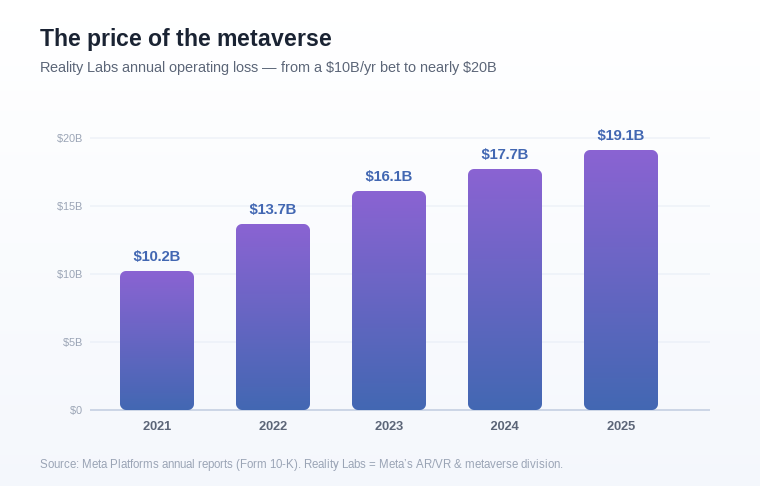
If anything, that $10 billion was the down payment. Reality Labs posted an operating loss of about $10.2 billion in 2021 on just $2.3 billion of revenue — and the losses only steepened from there: roughly $13.7 billion in 2022, $16.1 billion in 2023, and $17.7 billion in 2024. By 2025 the annual bleed reached $19.1 billion. In under five years, Meta had poured well over $60 billion into a vision that, by its own admission, was still a decade from mainstream.
Legless avatars and a credibility problem
The vision was expensive; the execution was, at first, awkward. In August 2022, Zuckerberg posted a screenshot of his Horizon Worlds avatar standing in front of a flat, cartoonish rendering of the Eiffel Tower. The internet did not receive it kindly. The graphics looked a generation behind a decade-old video game, and the avatars famously had no legs. Zuckerberg promised "major updates" and better selfies; the meme had already escaped. It crystallized a growing doubt: had one of the most powerful people in tech bet the company's identity on something people simply didn't want yet?
Inside Meta, the conviction held. Zuckerberg's dual-class shares gave him majority voting control — no board, no activist investor could force him to abandon the plan. He was, in the most literal sense, unfireable. That freedom had built the empire. Now it let him spend billions on a future no one else could see, on the strength of one man's certainty.
The trouble was that the future arrived faster somewhere else entirely. As Meta poured its energy into virtual worlds, a different revolution — generative AI — was about to reset every conversation in Silicon Valley, and the market's patience for a money-losing metaverse was running out. The stock hadn't yet felt the full weight of the bet. It was about to.
Next in Part 19 — "The Year of Efficiency": the stock collapses nearly 65%, Meta lays off more than 20,000 people, and Zuckerberg engineers one of the great comebacks in modern business.
Comments
Post a Comment