For most of its life, Facebook had grown by buying its way out of trouble. A scrappy photo app looked like a threat? Buy it. A messaging service was pulling in a billion users? Buy that too. For years, this was celebrated as visionary dealmaking. On December 8, 2020, the United States government reframed those same deals as the evidence in an antitrust case — and asked a court to undo them.
The complaint that named a strategy
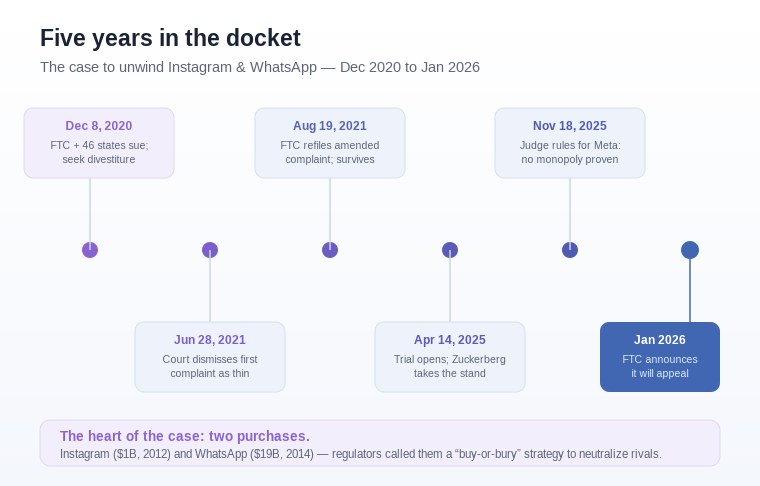
On that day the Federal Trade Commission, joined by 46 states, the District of Columbia, and the territory of Guam, filed suit against Facebook. A separate coalition of attorneys general, led by New York's Letitia James, filed its own parallel case the same week. The core accusation was blunt: Facebook held an illegal monopoly in personal social networking, and it had defended that monopoly not by building better products but by absorbing anyone who might one day compete.
Two purchases sat at the center of the argument. In 2012, Facebook bought Instagram, then a tiny photo-sharing startup with no revenue, for roughly $1 billion. In 2014, it bought the messaging app WhatsApp for about $19 billion — one of the largest acquisitions in tech history. At the time, both were waved through by regulators. Now the FTC argued that internal messages showed intent: Mark Zuckerberg had once written that it was “better to buy than compete.” The government's shorthand for the pattern became infamous — a “buy-or-bury” strategy meant to neutralize rivals before they grew large enough to matter.
The remedy the FTC sought was not a fine. It was structural. Regulators wanted the court to force Facebook to divest Instagram and WhatsApp — to break the company apart and rebuild the competition it had allegedly erased. For a company whose entire growth story rested on those two apps, it was the most serious existential threat it had ever faced from a government.
A case that almost died at the starting line
The reckoning did not arrive as a knockout blow. It arrived as a slog. On June 28, 2021, U.S. District Judge James Boasberg dismissed the FTC's original complaint as legally insufficient. His reasoning stung: the agency had asserted that Facebook held a monopoly but had, in the court's view, essentially assumed everyone simply agreed — without the market data to prove it. The states' parallel case fared even worse, running into arguments that they had waited far too long to challenge deals approved years earlier.
It was a genuine low point for the government's antitrust ambitions. But the FTC, now under Biden-appointed chair Lina Khan — a scholar who had built her reputation arguing that antitrust law had grown toothless against Big Tech — refiled. On August 19, 2021, the agency submitted an amended complaint packed with the market-share figures and detail the first attempt had lacked. This time it held. In January 2022, Judge Boasberg denied Facebook's motion to dismiss, and the case — now formally against Meta, the company's new name — was cleared to proceed toward trial.
What followed was years of grinding discovery: subpoenas to Snapchat and TikTok, fights over what “the market” even meant, and repeated attempts by Meta to have the whole thing thrown out. The company's central defense was elegant and, ultimately, powerful: how can we be a monopoly when people spend their days on TikTok and YouTube? The relevant market, Meta argued, was not some narrow “personal social networking” box the FTC had drawn — it was the whole roaring, competitive attention economy.
The verdict — and what it settled
The trial finally opened on April 14, 2025, and it opened with a spectacle: Mark Zuckerberg himself taking the witness stand on day one, walked through his own old emails about Instagram and asked to defend a decade of dealmaking under oath. For weeks the FTC and Meta fought over counterfactuals — what the internet would look like in a world where Facebook had never bought its two crown jewels.
On November 18, 2025, the answer came, and it went Meta's way. Judge Boasberg ruled in the company's favor. His logic cut to the heart of the government's problem: even if Facebook had once held monopoly power, the FTC had failed to prove it held that power now, in a landscape reshaped by TikTok's explosive rise. The counterfactual was too speculative; the present-day market too competitive. Meta would not have to give up Instagram or WhatsApp. In January 2026, the FTC announced it would appeal — a signal that, win or lose, the fight over whether these acquisitions should ever have been allowed was far from over.
The antitrust reckoning was, in the end, a paradox. The government spent five years and enormous resources trying to unwind the two deals that had defined Facebook — and lost. Yet the case dragged Meta's most private strategic reasoning into the daylight, put its founder on the stand, and forced a national argument about whether “buy the competition” should be a legal way to grow. The apps survived. The scrutiny didn't fade.
But even as Meta fended off Washington, a different kind of threat was rising — one no courtroom could adjudicate. Next time: a fifteen-second video app from China rewrites the rules of attention, and Facebook faces a rival it cannot simply buy.
Comments
Post a Comment