On the morning of April 10, 2018, the most powerful man in social media put on a dark suit and a blue tie, walked into a Senate hearing room, and sat down on a black leather chair that aides had quietly raised with a booster cushion. Cameras stacked three deep on the floor in front of him. Forty-four United States senators sat in a horseshoe above him. Mark Zuckerberg, who had built Facebook in a dorm room fourteen years earlier, was now there to answer for it.
He would spend nearly ten hours over two days under oath — the joint Senate Judiciary and Commerce committees on the first day, the House Energy and Commerce Committee on the second. Roughly a hundred lawmakers took turns. It was the closest thing the internet age had produced to a public reckoning, and it had been building for a long time.
How Facebook ended up in the dock
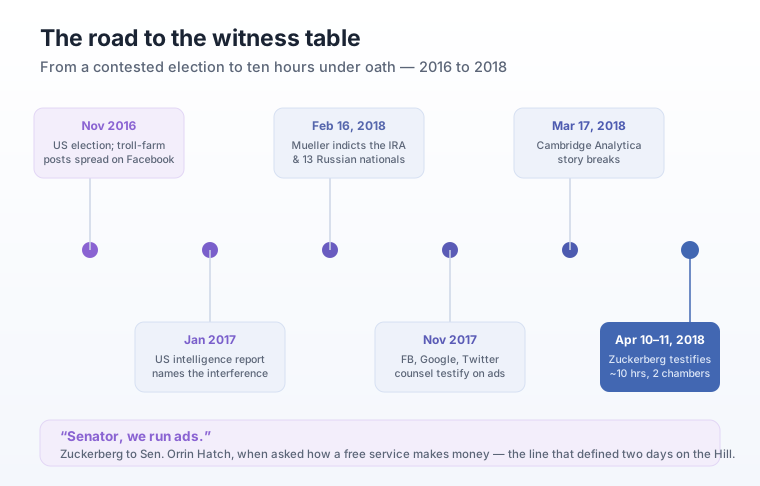
The immediate trigger was Cambridge Analytica. In mid-March 2018, The Guardian and The New York Times revealed that a personality-quiz app had quietly harvested the data of up to 87 million Facebook profiles and funneled it to a political consultancy that worked for the 2016 Trump and Cruz campaigns. Overnight, #DeleteFacebook was trending, the stock was sliding, and the company that liked to talk about "connecting the world" was suddenly being asked what, exactly, it did with the connections.
But Cambridge Analytica was only the spark. The deeper anxiety was about elections. By late 2017, Facebook had told Congress that content from the Kremlin-linked Internet Research Agency — a troll farm in St. Petersburg — may have reached as many as 126 million Americans on its platform over roughly two years, through a mix of some 3,000 paid ads and tens of thousands of organic posts from fake accounts pretending to be Americans. In January 2017, the U.S. intelligence community had named the interference outright. In February 2018, special counsel Robert Mueller indicted the IRA and thirteen Russian nationals. The question hanging over the room was blunt: had the platform that promised community instead become an instrument for manipulating one?
"Senator, we run ads"
What the hearings revealed, more than anything, was the gap between the lawmakers and the thing they were trying to regulate. Senator after senator struggled with the basics of how Facebook actually worked. The moment everyone remembers came from Orrin Hatch, the 84-year-old Republican from Utah, who leaned into his microphone and asked how the company could possibly stay in business when its users paid nothing to use it.
Zuckerberg paused, allowed himself the faintest smile, and said: "Senator, we run ads." Hatch replied, "I see." The clip went around the world within hours — not because it was a gotcha, but because it captured the whole dynamic. The men and women charged with holding Facebook accountable did not quite understand the business model that had made it one of the most valuable companies on earth: attention, harvested and sold to advertisers.
Zuckerberg, for his part, was relentlessly prepared. He apologized — "it was my mistake, and I'm sorry" — and returned again and again to a few rehearsed lines about responsibility and doing better. When questions got technical or uncomfortable, he deflected with a promise that his team would follow up. Investors, watching a CEO survive the ordeal without a stumble, breathed out: Facebook's shares actually rose during his first day of testimony, recovering billions in value.
An apology, and a scoreboard of promises
The hearings changed the mood without immediately changing the machine. Zuckerberg pledged more transparency in political advertising, promised investment in artificial intelligence to catch bad actors, and pointed to the tens of thousands of content reviewers Facebook was hiring. Some of that was real: the company rolled out an ad archive and "paid for by" labels on political ads, and it began disclosing takedowns of coordinated inauthentic accounts.
But the structural questions went unanswered. Nothing in the testimony required Facebook to change how it collected data, ranked content, or monetized outrage. No federal privacy law followed. The most concrete consequence arrived more than a year later, in July 2019, when the Federal Trade Commission hit Facebook with a record $5 billion fine over its privacy practices — a sum so large it made headlines, and so small against Facebook's revenue that the stock rose the day it was announced.
That was the paradox of April 2018. Zuckerberg had been hauled before Congress, made to answer, made to apologize on live television. And when it was over, the company was fundamentally intact, more valuable than when he sat down, and still operating on the same terms. The reckoning had been performed. The reckoning had not, yet, arrived.
It was coming. Because while Washington fumbled the questions about privacy and elections, a different set of regulators — antitrust lawyers at the FTC and in statehouses across the country — were quietly asking a far more dangerous one: not what Facebook does, but whether it should be allowed to be this big at all. Next in Part 17: the antitrust reckoning, and the case to break Facebook up.
Comments
Post a Comment