Artificial intelligence feels like it arrived overnight — one day we were typing search queries, the next we were holding conversations with machines. But AI has a long history, stretching back decades before ChatGPT. It is a story of bold ideas, crushing disappointments, and stubborn researchers who kept going through two “winters” when almost everyone else gave up. Here is the journey, from a single provocative question to the tools we use every day.
The question that started it all

Alan Turing, whose 1950 paper asked “Can machines think?” (Image: Wikimedia Commons)
In 1950, British mathematician Alan Turing published Computing Machinery and Intelligence, opening with a deceptively simple question: “Can machines think?” Rather than get lost in philosophy, he proposed a practical test — now called the Turing Test — in which a machine passes if a human judge cannot reliably tell it apart from a person in conversation. Turing did not have the hardware to build such a machine, but he gave the field its founding goal and its most famous benchmark.
The birth of a field (1956)

Early electronic computers like the ENIAC made the dream thinkable. (Image: Wikimedia Commons)
The term “artificial intelligence” was coined in 1956 at the Dartmouth Summer Research Project, organized by John McCarthy, Marvin Minsky, Nathaniel Rochester, and Claude Shannon. Their proposal boldly claimed that “every aspect of learning or any other feature of intelligence can in principle be so precisely described that a machine can be made to simulate it.” The optimism was enormous — some believed human-level AI was just a decade away. Early programs could prove mathematical theorems and play checkers, and it genuinely felt like the finish line was in sight.
Neural networks — and the first winter

The neural network — layers of simple units, loosely inspired by the brain. (Image: Wikimedia Commons)
In 1958, Frank Rosenblatt built the Perceptron, an early neural network that could learn to recognize patterns. But in 1969, Minsky and Papert showed that a single-layer perceptron couldn't solve even simple problems like the XOR function, and enthusiasm collapsed. Funding dried up through the 1970s in what became known as the first “AI winter.” The field pivoted to expert systems — hand-coded rules that captured human expertise — which briefly boomed in the 1980s before proving too brittle and expensive to maintain, triggering a second winter. Through it all, a small group kept refining neural networks, waiting for the hardware and data to catch up.
The machine that beat a world champion

IBM's Deep Blue, which defeated world chess champion Garry Kasparov in 1997. (Image: Wikimedia Commons)
In 1997, IBM's Deep Blue defeated reigning world chess champion Garry Kasparov — the first time a computer beat a top human at the game under tournament conditions. It was a watershed moment. Deep Blue didn't “think” like a person; it searched millions of positions per second. But it proved that machines could outperform humans at tasks long considered the pinnacle of intellect, and it captured the public imagination like nothing before it.
AI gets a body — and gets practical
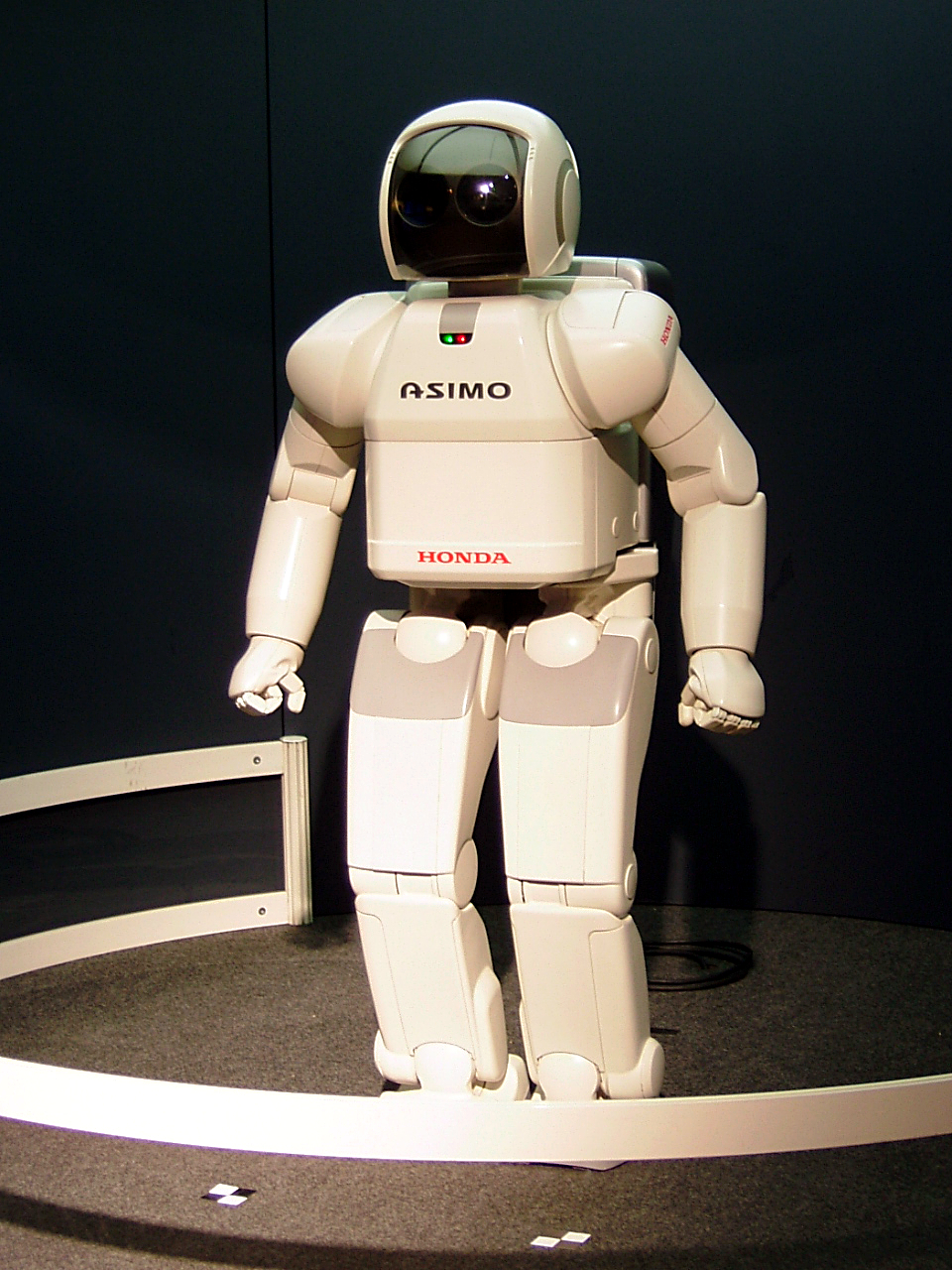
Honda's ASIMO — AI stepping into the physical world. (Image: Wikimedia Commons)
The 2000s brought AI out of the lab and into daily life. Humanoid robots like Honda's ASIMO walked and climbed stairs; spam filters, recommendation engines, and search algorithms quietly ran on machine learning instead of hand-written rules. The real turning point came in 2012, when a deep neural network called AlexNet crushed the field at the ImageNet image-recognition contest. Cheap GPUs and enormous datasets had finally arrived, and the long-dormant neural networks roared back to life. The era of deep learning had begun.
The generative era

ChatGPT put conversational AI into millions of hands. (Image: Wikimedia Commons)
In 2017, a Google paper titled Attention Is All You Need introduced the Transformer — the architecture behind nearly every modern AI system. It let models learn from vast amounts of text and understand context far better than anything before. That breakthrough led to the GPT family of large language models, and in late 2022, ChatGPT reached a hundred million users faster than any product in history. Suddenly anyone could write, code, summarize, and brainstorm with an AI. Today these models are multimodal — they see images, hear speech, and generate video — and they are woven into the tools engineers and writers use every day.
Where it goes from here
From Turing's question to a chatbot in your pocket took roughly seventy years — and two winters where the whole field nearly froze over. What changed wasn't one genius insight but the slow convergence of three things: better algorithms, faster hardware, and oceans of data. The lesson of AI's history is patience: ideas dismissed as dead ends for decades became the foundation of everything we use now. Whatever comes next — more capable agents, AI that reasons and plans, tools that quietly handle the tedious parts of our work — it will be built on the same long, stubborn arc that started with a single question: Can machines think?
Comments
Post a Comment