
By the autumn of 1980, Apple was no longer two guys and a soldering iron. It was a real company shipping the Apple II by the hundreds of thousands, with a headquarters in Cupertino, a professional CEO in Mike Scott, and a chairman—Mike Markkula—who had bet his own money and his Intel-honed instincts on the whole thing. The next logical step was the one that turns a startup into an institution: selling shares to the public. What nobody quite anticipated was that the offering would go down as the loudest financial event in Silicon Valley’s short history, and would mint a generation of millionaires in a single afternoon.
The offering that sold out in minutes
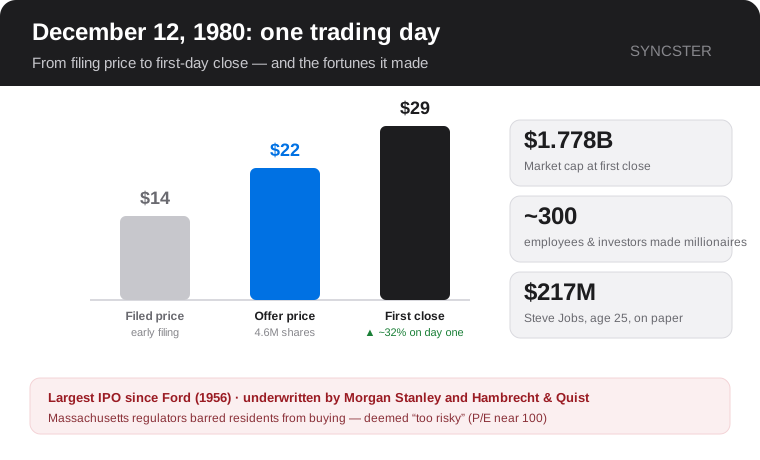
On December 12, 1980, Apple Computer went public. Underwritten by the blue-chip house Morgan Stanley alongside the scrappier tech specialist Hambrecht & Quist, the offering put 4.6 million shares on the market at $22 apiece. That price itself told a story—early filings had floated a figure closer to $14, but demand for a piece of the company behind the Apple II ran so hot that the bankers kept nudging the number upward.
They needn’t have worried about finding buyers. The stock sold out within minutes of opening. By the close of the first trading day it had climbed to roughly $29, a jump of about 32 percent, and Apple’s market capitalization stood at a startling $1.778 billion. The company had raised more than $100 million—the largest initial public offering the United States had seen since Ford Motor Company went public in 1956. A firm that had existed for barely four years was suddenly worth more than storied names that had been building things since before the war.
The day everyone got rich
The numbers on the ticker were abstract; the numbers on people’s personal balance sheets were not. The IPO is widely credited with creating more than 300 instant millionaires among Apple’s employees and early investors—a concentration of new wealth that had simply never happened at a single technology company before. Venture backers who had put in modest sums a few years earlier cashed out with returns measured in the thousands of percent.
The headline winner was, unsurprisingly, Steve Jobs. As Apple’s largest individual shareholder, the 25-year-old walked away from the first day of trading with a paper fortune of about $217 million. He had gone from a kid scrounging for parts in his parents’ garage to one of the wealthiest young men in America in less time than it takes most people to finish college. Steve Wozniak, the engineer whose circuit designs made the whole thing possible, was rich too—and characteristically, he chose to spread it around.
In what became known informally as the “Woz Plan,” Wozniak sold roughly $10 million of his own shares to fellow Apple employees at favorable prices, deliberately widening the circle of people who got to share in the windfall. It was a gesture Jobs pointedly declined to match, and the contrast said a great deal about the two founders’ temperaments—one wired for generosity and engineering fellowship, the other for empire.
Too risky for Massachusetts
Not everyone was invited to the party. In one of the great cautionary tales of financial regulation, securities regulators in Massachusetts barred the state’s residents from buying Apple shares in the offering, deeming the stock “too risky” for individual investors. Their reasoning wasn’t crazy on paper: Apple’s price-to-earnings ratio was pushing 100, a valuation that looked wildly speculative by the conservative standards of 1980. A young company, an unproven industry, a multiple that dwarfed anything on the blue-chip boards—caution seemed prudent.
History, of course, has had its laugh. The company those regulators judged too dangerous for ordinary people went on to become the first business ever valued at three trillion dollars. Anyone who bought at that $22 offer price and simply held on—through splits, crashes, near-bankruptcy, and reinvention—would have turned a small stake into a fortune. The Massachusetts ban endures as a favorite parable about the limits of trying to protect people from their own upside.
Beyond the personal fortunes, the IPO changed something structural in Silicon Valley. It proved that a technology startup could go from garage to billion-dollar public company in a handful of years, and that stock options handed to rank-and-file engineers could make ordinary employees genuinely wealthy. That template—equity as the currency of ambition—became the beating heart of how the Valley recruited, retained, and motivated talent for the next four decades. Apple didn’t just get rich in December 1980; it wrote the playbook everyone else would follow.
Yet all that money bought Apple a new kind of pressure. A public company answers to shareholders, and shareholders want the next big thing. The Apple II was a cash machine, but it wouldn’t last forever—and Jobs, newly minted and newly restless, was already hunting for what came after it. He would find it not in Cupertino, but on a field trip to a research lab in Palo Alto, where a group of engineers had quietly invented the future and didn’t seem to know what to do with it.
Next in the series: how a single visit to Xerox PARC—the mouse, the windows, the desktop—set Apple on the road to reinventing the computer itself.
Comments
Post a Comment