When Steve Jobs walked back into Apple in late 1996, the company he had co-founded two decades earlier was a mess. It was selling 1.8 million Macs a year, down from 4.5 million just two years before. The product line was a thicket of overlapping Performas and PowerBooks with names only a spreadsheet could love. Jobs did two things that looked, on the surface, like marketing and housekeeping. In hindsight they were the same move: he decided that from now on, Apple would lead with meaning and design — and let the engineering follow.
“Think different” — a bet on identity
The first signal came before a single new computer shipped. In 1997, with Apple still bleeding, an internal pitch floated the slogan “We’re back.” Jobs shot it down flat — he thought it was stupid, because Apple wasn’t back yet. Instead he invited three agencies to pitch a campaign that captured what he believed the company stood for. His old partner Chiat\Day (by then TBWA\Chiat\Day) won with two words that would outlive the crisis entirely: Think different.
Art director Craig Tanimoto coined the line, written up with creative directors Rob Siltanen, Lee Clow and Ken Segall. It was widely read as a wink at IBM’s decades-old one-word motto, “Think.” Grammarians complained it should be “think differently,” but Jobs insisted on “different” as a noun — like “think big” or “think victory.” The campaign paired black-and-white portraits of Einstein, Gandhi, Picasso, Ali and others with the slogan. Jobs personally worked the phones to secure the likenesses, calling the families of Jim Henson and John F. Kennedy, and flying to New York to ask Yoko Ono in person. As Siltanen later put it, Jobs didn’t write the ad, “but there’s not a shot in hell” a campaign that big gets off the ground without him. It turned a brand people thought of as “semi-cool but semi-stupid” into something aspirational again — before the products arrived to back it up.
Four boxes on a whiteboard
Behind the ads, Jobs ran the same ruthless edit on the catalog. He drew a simple two-by-two grid: Consumer and Pro across the top, Desktop and Portable down the side. Four squares. Apple would make one great machine for each. Everything that didn’t fit a box got killed. It was a strategy you could explain to an engineer in ten seconds, and it forced every team to answer one question — who is this for? — before writing a line of code.
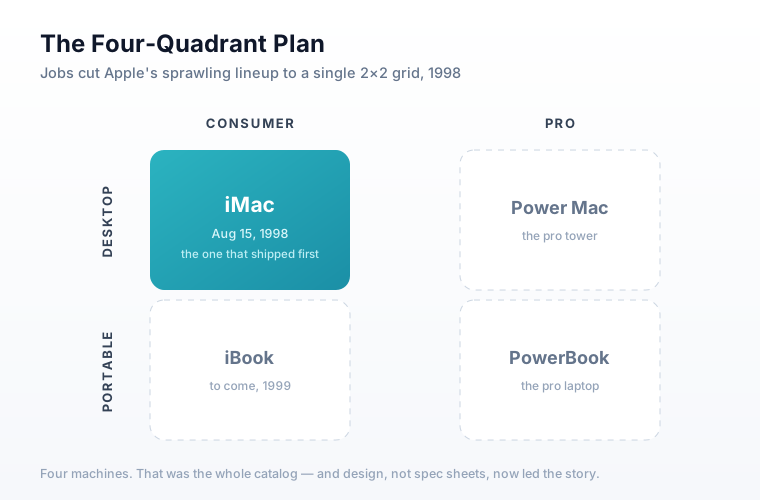
The first box to fill was consumer desktop. That machine would have to do something the slogan only promised: prove Apple could still surprise people.
The iMac: design as the whole argument
On August 15, 1998, Apple shipped the iMac — the first major product of Jobs’s second act. At $1,299 it was aimed squarely at ordinary buyers who wanted to get on the internet without a manual (the “i” stood for internet). But what people remembered wasn’t the price or the processor. It was the look.
Apple’s design chief Jony Ive — recently promoted after Robert Brunner left, and who had nearly quit in frustration before Jobs made industrial design central to the comeback — wrapped the whole computer in a single teardrop-shaped shell of translucent “Bondi Blue” plastic. You could see into it. In an industry of beige boxes, that was close to heresy. Ive’s team even invented new manufacturing methods to finish it in time.
Just as bold was what Ive and Jobs threw out. The iMac had no floppy drive — then still considered essential — and none of the legacy serial ports Mac users relied on. In their place: a CD-ROM drive and the then-new USB standard. Critics were split, grumbling about the missing floppy and the awkward round mouse, and warning the machine was really only for beginners.
Buyers disagreed, loudly. The iMac became Apple’s fastest-selling computer, moving past six million units over its life and spawning a rainbow of candy colors that other companies rushed to copy — translucent staplers, grills and George Foreman… everything. It is widely credited with pulling Apple back from the edge of ruin and, more lastingly, with turning the personal computer from a technical appliance into a consumer object people actually wanted on their desk.
The deeper lesson sat under the plastic. “Think different” and the iMac were two halves of one idea: that design and story could be the strategy, not the gift wrap. Apple wasn’t back because it out-spec’d anyone. It was back because it had, once again, something to say — and an object that said it the moment you walked past.
Next time: the gamble that let all of this run — a brand-new operating system, built on the bones of the company Jobs brought with him. Mac OS X arrives.
Comments
Post a Comment