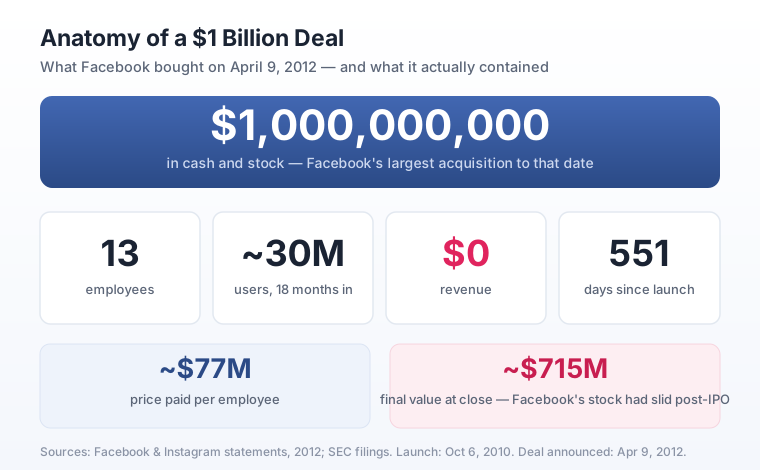
By the spring of 2012, Mark Zuckerberg had spent almost a decade learning a hard lesson about the internet: the thing that kills you is rarely the competitor you can see. It is the small, fast product your users quietly fall in love with while you are busy running a giant. On the evening of April 5, 2012, Zuckerberg found himself staring at exactly such a product — a photo-sharing app called Instagram, barely eighteen months old, with thirteen employees and not a cent of revenue. Four days later, he agreed to buy it for a billion dollars.
A tiny company with a terrifying growth curve
Instagram had launched on October 6, 2010, the work of two Stanford graduates. Kevin Systrom — a former Google engineer who had once turned down a job offer from Zuckerberg and interned at Odeo, the startup that became Twitter — had built a clunky check-in app called Burbn. Together with Mike Krieger, he stripped it down to the one feature people actually used: posting a square photo, running it through a nostalgic filter, and sharing it. The pared-back app hit the App Store and gained 25,000 users on its first day.
The numbers only got scarier from there. Instagram was, for its first eighteen months, an iPhone-only app — and it still crossed roughly 30 million users. Then, on April 3, 2012, the company finally shipped its Android version. It was downloaded more than a million times in a single day. A week before that, Instagram had closed a fresh round of about $50 million from investors including Sequoia Capital, at a valuation of around $500 million. A company with no business model had just been priced at half a billion dollars, and its growth was accelerating. For Zuckerberg, that curve was the whole story: mobile photos were becoming the core social behavior on earth, and Facebook did not own it.
A weekend deal, negotiated at the kitchen table
What happened next has become Silicon Valley legend precisely because of how it was done. Zuckerberg negotiated most of the deal himself, largely from his home in Palo Alto, over the course of about three days. Facebook's board was reportedly briefed only after the terms were essentially settled — a level of unilateral control few CEOs could get away with, but Zuckerberg's dual-class shares gave him exactly that. He wanted Instagram closed before Facebook's own IPO, then just weeks away, when a public company's every acquisition would be dissected by analysts.
The announced price was $1 billion in cash and stock, making it the most expensive acquisition in Facebook's history to that point. Split across thirteen employees, that worked out to something like $77 million per head — a figure so absurd it became shorthand for the entire mobile land grab. Systrom, who owned a large slice of the company, stood to make several hundred million dollars before his thirtieth birthday. Crucially, Zuckerberg promised Instagram something Facebook rarely offered: independence. Systrom and Krieger would keep running their app as a separate brand rather than being folded into the blue machine.
The bargain the numbers hid
There is a wrinkle to the billion-dollar headline. Because a chunk of the price was paid in Facebook stock, and because Facebook's shares slumped badly after its rocky May 2012 IPO, the deal's value had actually shrunk by the time it formally closed that September — to roughly $715 million. The most famous billion-dollar acquisition in tech history did not, in the end, quite cost a billion dollars.
And yet, within a few years, the reaction flipped completely. The commentators who had mocked Zuckerberg for overpaying for a toy fell silent as Instagram grew past a billion users and, eventually, into a business contributing well over $20 billion a year to its parent company. What looked in 2012 like the pinnacle of bubble-era excess turned out to be one of the shrewdest purchases ever made — a defensive move against mobile disruption that quietly became one of Facebook's greatest offensive weapons.
But buying the future does not make you immune to it. Instagram had beaten Facebook to the camera; someone else was about to beat Facebook to something else entirely — and this time, the founder would say no. Next: the messaging war, and the acquisition that cost nineteen billion dollars.
Comments
Post a Comment