By the summer of 2008, Facebook had already won the campus and beaten MySpace. But winning the present is not the same as owning the future. Somewhere inside the company, a quieter and more consequential idea was taking hold: growth was not something that happened to a product. It was something you could build, measure, and engineer — like any other system. Over the next two years that idea would carry Facebook from its first 100 million users to half a billion, and it would give Silicon Valley one of its most famous, and most argued-over, four-word mottos.
Move fast and break things
The phrase was scrawled on posters around Facebook's offices long before anyone outside the company had heard it. It was an engineering credo first: ship the code, learn from what happens, fix it in the next push. Perfection was the enemy; velocity was the point. A feature that shipped Tuesday and got iterated on Wednesday beat a flawless feature that shipped next quarter.
Mark Zuckerberg made it official in the founder's letter attached to Facebook's 2012 IPO filing, under a section he titled “The Hacker Way.” “Moving fast enables us to build more things and learn faster,” he wrote. “We have a saying: ‘Move fast and break things.’ The idea is that if you never break anything, you're probably not moving fast enough.” It was a philosophy tuned for a scrappy company that could afford to stumble.
What most people who quote the slogan forget is that Facebook eventually retired it. In April 2014, on stage at the company's F8 developer conference — with Facebook now serving well over a billion people — Zuckerberg announced the mantra had changed to “Move fast with stable infrastructure.” He explained the logic bluntly: when you're small, breaking things is cheap and speed is everything. When a broken deploy affects a billion people at once, the time you spend cleaning up costs more than the speed you gained. Facebook paired the new motto with a two-year API stability guarantee for outside developers. The reckless-sounding creed had grown up alongside the company that coined it.
Growth as a science
Speed was the culture; the Growth team was the machinery. Around 2007 Facebook created a dedicated group whose only job was to acquire, activate, and retain users — one of the first formal “growth teams” in the industry, a role that barely existed as a job title before Facebook made it one. It was led by Chamath Palihapitiya, an executive who treated user growth less like marketing and more like a physics problem.
The team's most famous discovery was almost absurdly specific. Digging through cohorts of users who stuck around versus those who drifted away, they found a single behavior that predicted retention better than anything else: getting a new user to seven friends in ten days. Reach that threshold and a user tended to stay; miss it and they tended to fade. “The single biggest thing we realized was to get any individual to 7 friends in 10 days,” Palihapitiya later recalled. “That was it… There was not much more complexity than that.” The company, he said, “talked about nothing else.”
That one number became a North Star. Everything — the friend-recommendation engine, the contact importer, the relentless email nudges reminding you that someone had tagged you or requested your friendship — existed to push new arrivals across that line as fast as possible. Facebook wasn't just hoping people would connect. It was systematically manufacturing the connections that made the product sticky.
Half a billion, on schedule
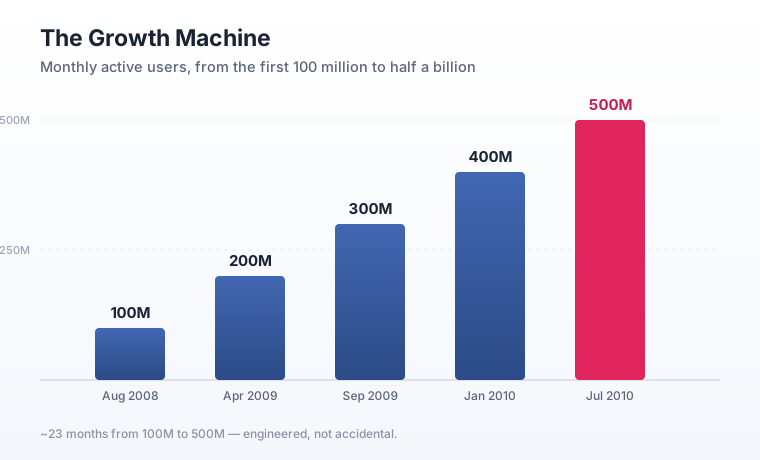
The results read like a machine accelerating. Facebook crossed 100 million users in August 2008. It hit 200 million in April 2009, then 300 million that September — a hundred million more in barely five months. It passed 400 million in early January 2010, and on July 21, 2010, Zuckerberg published a blog post titled “500 Million Stories.” In roughly 23 months the platform had five-x'd, and the pace between milestones kept shrinking rather than stretching out. That is the signature of compounding done deliberately.
Numbers like these also reframed what Facebook was. A site for half a billion people is no longer a website; it is infrastructure. It is where families share photos, where movements organize, where businesses expect to be found. The growth machine had done exactly what it was built to do — and in doing so it created responsibilities the “break things” era had never planned for. When your product mediates the daily social life of a meaningful slice of humanity, the things that break are no longer just servers and features.
That tension — between the hacker culture that built Facebook and the sheer scale of what it became — would define the years ahead. The growth was real, engineered, and astonishing. The bill for it was still being tallied.
Next: the numbers get real. With half a billion users and no profits to show shareholders, Facebook has to answer the question every free product eventually faces — how do you actually make money?
Comments
Post a Comment