For eight years, Mark Zuckerberg had said no. No to Viacom's reported $750 million in 2006, no to Yahoo!'s $1 billion the same year, no to the very idea of being anyone's public company. "We are definitely in no rush," he told the world in 2010. But rules are rules: once Facebook crossed 500 shareholders of record, the SEC's disclosure clock started ticking, and a private company forced to report like a public one might as well be one. On February 1, 2012, Facebook filed its S-1. On May 18, 2012, it rang the Nasdaq bell. And within weeks, the most anticipated technology offering in history had become a cautionary tale.
The biggest debut Wall Street had ever seen
The numbers were staggering by design. Facebook's prospectus reported 845 million monthly active users and 2.7 billion daily likes and comments. Demand was so heavy that underwriters — led by Morgan Stanley — pushed the price to the very top of the range: $38 a share. Two days before the debut, the company boosted the size of the deal by 25%, selling roughly 421 million shares. That valued Facebook at about $104 billion, the largest valuation ever for a company going public. It raised around $16 billion, the biggest tech IPO in history to that point.
Everyone wanted in. Retail investors who felt they'd missed Google's post-IPO moonshot piled into their brokerage accounts. LinkedIn had doubled on its first day the year before; surely the social network with a billion users would do the same. Even the pre-game drama fit the myth — Zuckerberg wore a hoodie to a room full of institutional investors, and a Wedbush analyst called it "a mark of immaturity." It only made the story better. This was going to be the debut of the decade.
The day the machinery broke
The trouble started before a single share traded. Facebook's opening was scheduled for 11:00 a.m. Eastern; it slipped past 11:30 as Nasdaq's systems buckled under the flood of orders. The exchange's software, tasked with matching the enormous volume of buys and cancellations, fell into a loop and jammed. For hours, traders had no idea whether their orders to buy — or to cancel — had actually gone through. Some investors thought they were out of the stock when they still owned it; others bought again to be sure. Nasdaq later paid a $10 million SEC penalty over the botched open, and set up a fund to compensate firms for their losses.
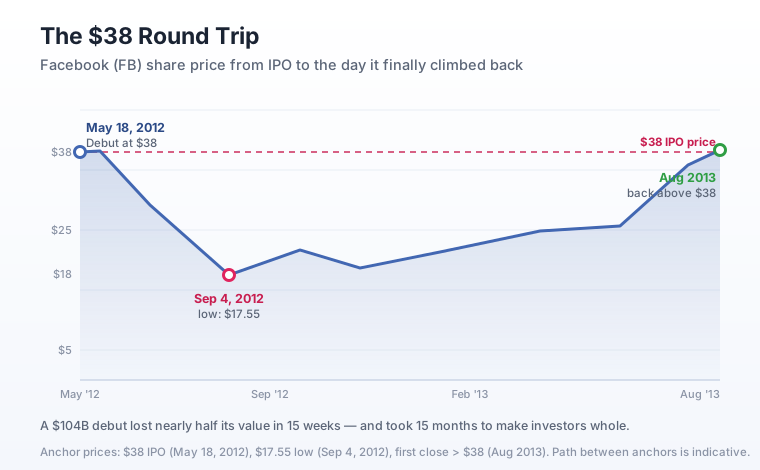
Underneath the technical chaos was a valuation problem. The stock opened around $42, poked higher, then began to sink toward the $38 offer price. Only heavy buying by the underwriters — defending the deal — kept it from closing below the line. Facebook finished its first day at $38.23, a gain of barely 0.6%. For an IPO built on the promise of a first-day "pop," a flat close was its own kind of verdict. And it was all downhill from there.
The slow-motion collapse — and a quieter scandal
The following Monday, the stock broke $38 and kept falling: $34, then $31, then into the twenties. By September 4, 2012, Facebook touched an all-time low of $17.55 — less than half its debut price. Roughly $50 billion of market value had evaporated in fifteen weeks. Investors who'd bought the dream at $38 were nursing brutal losses, and the financial press had found its favorite punching bag of the year.
Then came the accusations. During the IPO roadshow, Facebook had amended its filing to flag a worry: revenue wasn't keeping pace with the surge in users, especially as people shifted to mobile phones where Facebook barely made money. Analysts at the underwriting banks reportedly trimmed their revenue estimates in response — but that cautionary information appeared to reach select institutional clients, not the retail investors buying at the top. Lawsuits followed, alleging selective disclosure, and regulators opened inquiries. Massachusetts fined Morgan Stanley $5 million over how its analysts' views were handled. The optics were terrible: the little guy bought the hype while the big guy got the warning.
The irony is that the "flop" was, in hindsight, a company whose only real crime was going public before its business caught up with its audience. The mobile problem the roadshow whispered about would, within two years, become Facebook's greatest strength — mobile ads went from a rounding error to the majority of revenue. When strong mobile results landed in the summer of 2013, the stock finally clawed back the ground it had lost, closing above $38 for the first time in August 2013. It never looked back.
But that recovery was more than a year away. In the autumn of 2012, Facebook was a wounded stock, a punchline, and a company that had to prove it could actually make money on the phones its billion users now carried everywhere. Next: the pivot to mobile — how Facebook bet the company on the small screen, and won.
Comments
Post a Comment