On the evening of February 9, 2014, Mark Zuckerberg invited Jan Koum over to his house for dinner. Ten days later, Facebook announced it was buying Koum's company, WhatsApp, for roughly $19 billion — the largest acquisition in the company's history, and one of the biggest tech deals ever struck. For a messaging app with no advertising, no games, and barely fifty employees, the number seemed almost absurd. To understand why Zuckerberg paid it, you have to understand what he was actually afraid of.
The man who signed the deal outside a welfare office
Jan Koum's story is the kind Silicon Valley likes to tell about itself. Born near Kyiv in 1976, he emigrated to Mountain View, California with his mother and grandmother at sixteen. The family relied on food-stamp support and lived in a small subsidized apartment; Koum swept floors at a grocery store while his mother babysat. He taught himself programming from second-hand manuals, dropped out of San Jose State, and landed at Yahoo as an infrastructure engineer, where he spent nine years alongside a colleague named Brian Acton.
In 2007 the two quit Yahoo, traveled, and both applied for jobs at Facebook. Both were rejected. Acton's now-famous tweet — “Facebook turned me down… Looking forward to life's next adventure” — reads very differently in hindsight. Koum bought an iPhone in early 2009, saw that Apple's months-old App Store was about to birth an industry, and incorporated WhatsApp Inc. on his 33rd birthday. Acton came aboard after rounding up $250,000 in seed money and earned co-founder status. When it came time to sign the acquisition papers with Facebook in 2014, Koum reportedly drove to the former welfare office where he had once queued for food stamps and signed the documents on its door.
Why $19 billion, and how it was paid
The headline figure was never a single pile of cash. The deal was carefully layered: about $4 billion in cash, roughly $12 billion in Facebook stock, and an additional $3 billion in restricted stock units for WhatsApp's founders and employees, vesting over four years to keep the team in place. Because so much of the price was equity, and Facebook's share price rose between signing and closing, the deal's final value had climbed to around $21.8 billion by the time it officially completed in October 2014.
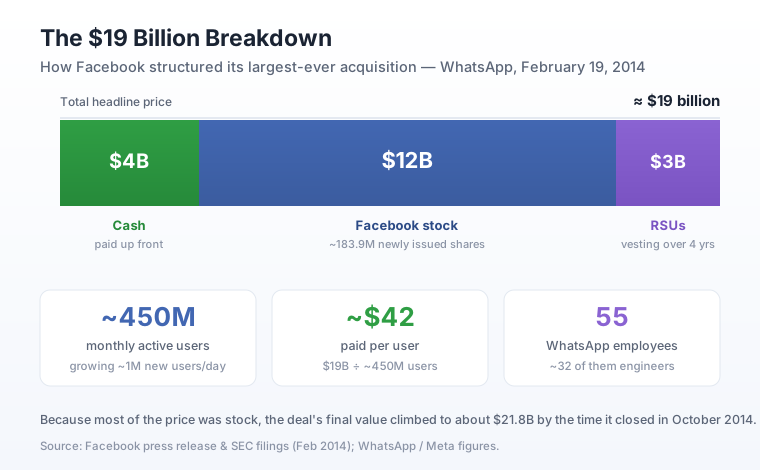
Run the math on a per-user basis and the logic starts to surface. WhatsApp had roughly 450 million monthly active users at the time, adding around a million new users a day, on track for a billion. At $19 billion, Facebook was paying about $42 per user — steep, but not insane for an audience growing that fast, especially one concentrated in Europe, Latin America, India, and Africa, exactly the international markets where Facebook wanted to entrench itself. And it was buying all of that with a team of just 55 people, only about 32 of them engineers, running a service on lean Erlang servers that handled tens of billions of messages a day.
Buying the threat, not just the app
The real motivation was defensive. Zuckerberg had already watched mobile messaging become the front door to people's phones. WhatsApp was doing to SMS what Facebook had done to email-era social networking — and it was doing it on mobile, the battlefield Facebook had nearly lost at its IPO. A messaging network with hundreds of millions of daily users was precisely the kind of company that could grow into a rival social graph. Having failed to buy Snapchat a few months earlier, Zuckerberg was not going to let the biggest independent messenger on Earth stay independent.
The acquisition also came with promises. Koum joined Facebook's board of directors, and both founders were assured WhatsApp would keep its independence, its ad-free experience, and its minimal data collection. Koum, whose distrust of advertising and surveillance was rooted in a childhood under Soviet monitoring, had a note taped to his desk: “No Ads. No Games. No Gimmicks.” For a while, Facebook honored it.
That truce would not last. Within a few years, clashes over monetization, data-sharing, and encryption would drive both founders out — Acton in 2017 and Koum in 2018, the latter declaring he had “sold my users' privacy.” But in February 2014, none of that was visible. Facebook had just paid a record sum to lock down the future of mobile messaging, and WhatsApp would go on to pass a billion, then two billion, then three billion users under its new owner.
The check was written. The bigger question — whether a company can buy a rival and still keep the promises it made to do so — was only beginning. Next: the other bet Zuckerberg placed in 2012, on a photo-sharing app called Instagram.
Comments
Post a Comment