By early 2014, Facebook had spent a decade perfecting the art of capturing attention on screens people already owned — the desktop browser, then the smartphone. So when Mark Zuckerberg wrote a $2 billion check for a company that made a clunky headset you strapped to your face, the reaction ranged from confusion to outright ridicule. Facebook didn't just buy a product. It bought a bet on what would replace the smartphone entirely — and it has been paying for that bet, in cash and in credibility, ever since.
A garage, a Kickstarter, and a legend
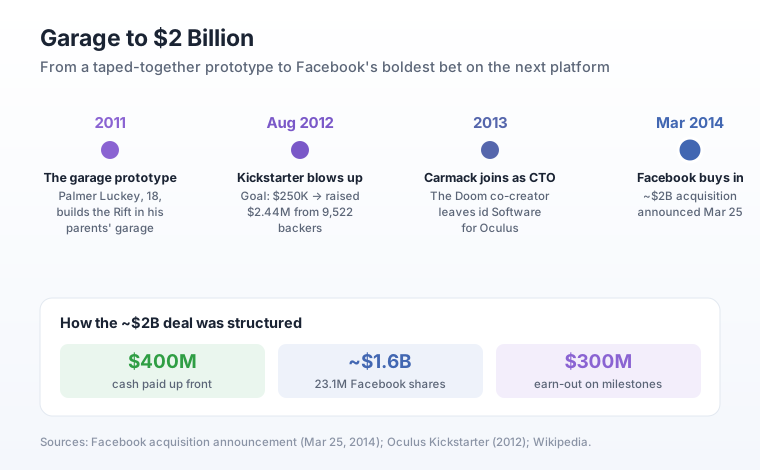
The origin story of Oculus is almost too clean. In 2011, an 18-year-old named Palmer Luckey was building virtual-reality headsets in his parents' garage in Long Beach, California. He had assembled what was reportedly the largest personal collection of head-mounted displays in the world, and he was convinced he could do better — a headset that was higher-performance than anything on the market and, crucially, cheap enough for gamers to actually buy.
His prototype found its way to John Carmack, the co-creator of Doom and one of the most revered engineers in gaming. Carmack was smitten, calling it the most immersive HMD he had ever used. At the 2012 Electronic Entertainment Expo, he demoed a duct-taped Oculus Rift running his software, and the industry took notice. That summer Luckey launched a Kickstarter campaign, “Oculus Rift: Step Into The Game.” The goal was $250,000. It raised more than $2.4 million from over 9,500 backers — a signal that the appetite for VR was real. By 2013, Carmack had left id Software to become Oculus VR's chief technology officer. A garage project had become the most credible virtual-reality company on Earth.
The $2 billion phone call
On March 25, 2014, Facebook announced it was acquiring Oculus VR for roughly $2 billion: about $400 million in cash, some 23.1 million shares of Facebook stock worth around $1.6 billion, and an additional $300 million tied to hitting future milestones. For a company with a few dozen employees and no shipping consumer product — only development kits — it was an astonishing sum.
Zuckerberg's framing made the logic clear. Mobile, he argued, was the platform of today, but Facebook wanted to be ready for the platforms of tomorrow. He described virtual reality as a new communication platform where, one day, you would feel truly present with another person — sharing spaces and experiences rather than just photos and text. Where the WhatsApp deal a month earlier had been about the present of communication, Oculus was a wager on its future. Facebook wasn't going to be caught flat-footed by the next computing shift the way others had been caught by mobile.
The backlash and the long road
Not everyone was thrilled. Many of the Kickstarter backers who had funded a scrappy, independent gaming startup felt betrayed to see it swallowed by the world's largest social network. Markus “Notch” Persson, the creator of Minecraft, publicly cancelled talks to bring his game to the Rift, tweeting that Facebook “creeps me out.” The tension exposed a fault line that still runs through the project: gamers wanted an open playground, while Facebook wanted the next place to gather — and monetize — billions of people.
The consumer Oculus Rift finally shipped in March 2016, nearly two years after the acquisition. Over the following years the division absorbed more companies and initiatives, was renamed Facebook Reality Labs, and eventually became simply Reality Labs — the engine room behind Zuckerberg's 2021 decision to rename the entire company Meta. That obsession has been staggeringly expensive. Reality Labs has bled tens of billions of dollars, posting an operating loss of roughly $19 billion in 2025 alone against just over $2 billion in revenue. It remains the purest expression of Zuckerberg's willingness to spend enormous sums today on a platform that may not fully arrive for another decade — if it arrives at all.
Whether the Oculus bet ultimately looks like foresight or folly, it marked a turning point: the moment Facebook stopped defining itself by the screens people already had, and started trying to build the next one.
Next time: the algorithm that ate the world — how the News Feed grew from a controversial experiment into the most powerful attention machine ever built.
Comments
Post a Comment