For most of Facebook's first decade, the story was about growth — more users, more revenue, more of the world wired into one social graph. In March 2018 the story flipped. For the first time, the question everyone was asking was not how big Facebook could get, but what it had quietly let slip out the back door. The answer had a name that would haunt the company for years: Cambridge Analytica.
A quiz, a loophole, and 87 million people
It started innocently enough — a personality quiz. In 2013 a Cambridge University researcher named Aleksandr Kogan built a Facebook app called “This Is Your Digital Life.” It presented a survey, paid users a small sum to complete it, and promised the data was for academic research. Around 270,000 people installed it and clicked allow.
That should have been the end of the exposure — 270,000 consenting adults. But this was the era of Facebook's original Open Graph platform, and the platform did something few users understood: when you granted an app permission, it could also reach into the profiles of all your Facebook friends. Your quiz answer became a doorway into everyone you knew. Through that loophole, Kogan's app harvested the personal data of up to 87 million profiles — the overwhelming majority of whom had never heard of the quiz, let alone taken it.
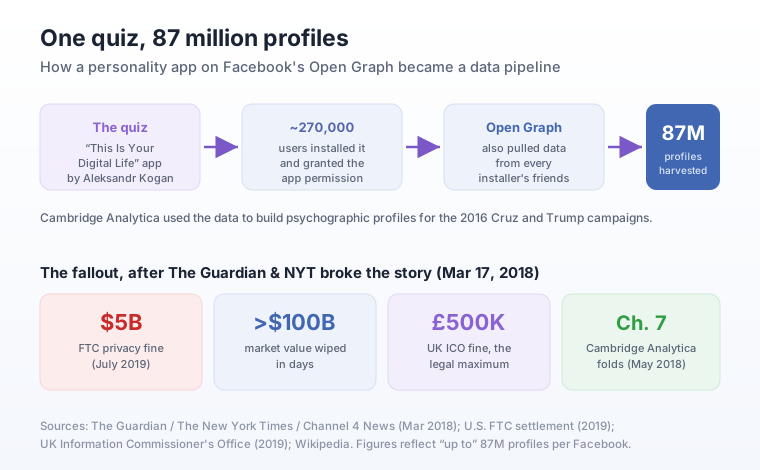
Kogan passed the data to Cambridge Analytica, a political consulting firm and offshoot of the UK's SCL Group. The firm's pitch was seductive: feed it enough digital breadcrumbs — likes, posts, the shape of your social connections — and it could build a “psychographic” profile of your personality, then target you with political messaging tuned to your fears and values. Cambridge Analytica put that pitch to work for the 2016 US presidential campaigns of Ted Cruz and, later, Donald Trump. Whether the targeting actually swung votes remains fiercely debated. What was not debatable was how the raw material had been obtained.
The whistleblower and the reckoning
The collection had been reported in fragments as early as December 2015, when The Guardian's Harry Davies noted Cambridge Analytica's work for the Cruz campaign. But it took a person to turn a data-policy footnote into a global scandal. That person was Christopher Wylie, a pink-haired former Cambridge Analytica employee who had helped build the very system he came to regret. Journalist Carole Cadwalladr spent roughly a year coaxing him to go on the record.
On March 17, 2018, The Guardian's sister paper The Observer and The New York Times published simultaneously, with Channel 4 News in the UK adding hidden-camera footage of Cambridge Analytica executives. The reaction was instant and brutal. More than $100 billion was knocked off Facebook's market value within days. The hashtag #DeleteFacebook trended worldwide. Regulators on both sides of the Atlantic demanded answers, and this time “we'll do better” would not be enough.
Facebook's initial response made things worse. The company's first instinct was to argue this was not technically a “breach” — no servers had been hacked; the data had flowed out through features working exactly as designed. That was true, and it was precisely the problem. The platform itself had been the leak.
The bill comes due
Mark Zuckerberg, who had stayed silent for five days, eventually apologized and agreed to do the thing tech founders dread most: sit in front of lawmakers. In April 2018 he testified before the US Congress — a moment we'll unpack in the next part. The financial and legal consequences stacked up over the following year. In July 2019 the US Federal Trade Commission hit Facebook with a $5 billion fine for privacy violations, at the time the largest such penalty in the agency's history. In the UK, the Information Commissioner's Office fined the company £500,000 — the legal maximum under the old rules — for exposing user data to a “serious risk of harm.” Cambridge Analytica itself did not survive; it filed for Chapter 7 bankruptcy in May 2018 and shut down.
The deeper cost was harder to put on a balance sheet. Cambridge Analytica became shorthand for a dawning public unease — the realization that “free” services were paid for in personal data, and that the friendly permission prompts nobody read could quietly enroll millions of strangers. Facebook had spent years telling the world that connecting everyone was an unalloyed good. Now regulators, journalists, and ordinary users were asking a harder question: connected to whom, and at what price?
The scandal forced Facebook to lock down the platform that had made apps like Kogan's possible, tightening data access it had once handed out freely. It also permanently changed how the company was perceived — no longer the plucky campus startup, but a global utility whose defaults could reshape elections. The techlash had a poster child, and its name was Cambridge Analytica.
Next in the series: Zuckerberg finally faces Washington — the congressional hearings, the viral “Senator, we run ads” moment, and Facebook's collision with elections and misinformation.
Comments
Post a Comment