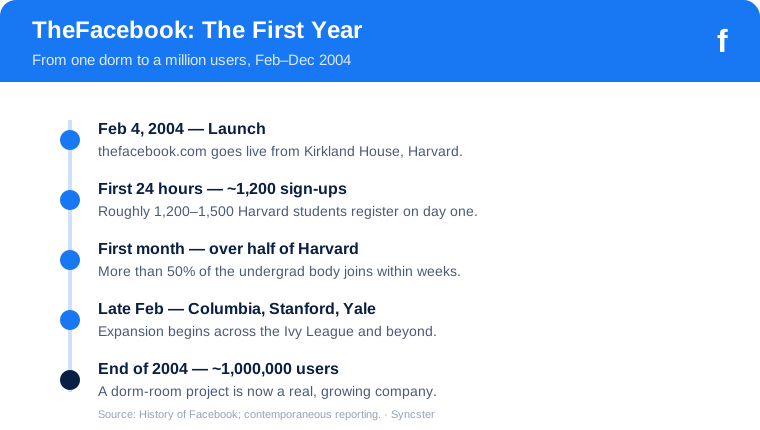
Three months after Harvard forced Facemash offline, Mark Zuckerberg was back at his keyboard in Kirkland House — this time building something people would volunteer to join. On February 4, 2004, he registered a modest URL, thefacebook.com, and flipped it live. There was no launch event, no press release, no business plan. Just a login box, a masthead with a blurry face on it, and a promise: a directory of Harvard students, made by students, that you filled in yourself.
It spread like a fever.
The dorm room that became a company
Zuckerberg didn't build it alone. TheFacebook came together with a small crew of Harvard roommates and friends, each of whom would later be counted among its co-founders. Eduardo Saverin, an economics student with a head for money, put up the first working capital and took on the business side. Dustin Moskovitz, Zuckerberg's roommate, threw himself into the code and the frantic work of adding new schools. Chris Hughes became the product's voice and de facto spokesman, and Andrew McCollum handled graphics — including that hazy face on the early masthead.
What separated it from Facemash was consent. Where Facemash had scraped people's photos to rank them without asking, TheFacebook inverted the whole idea: you signed up, you uploaded your own picture, you listed your year, your classes, your relationship status, your interests. It was a directory people wanted to appear in, because appearing in it — and browsing everyone else — was the entire point. To keep it feeling safe and real, registration required a valid harvard.edu email address. That single constraint did two things at once: it guaranteed real identities, and it made the site feel like an exclusive club.
1,200 sign-ups in a day
The numbers were immediate and absurd. Within the first 24 hours, somewhere between 1,200 and 1,500 Harvard students had registered. Within the first month, more than half of Harvard's undergraduate population had an account. This wasn't a slow-burning experiment that found its audience over a year; it saturated a closed community almost instantly, because a campus is exactly the kind of dense social network where "everyone else is already on it" becomes true within days.
And here was the insight Zuckerberg had been circling since Facemash: people are endlessly fascinated by other people they actually know. Not celebrities, not strangers — the guy from lecture, the girl down the hall, the person you met once at a party. TheFacebook gave that curiosity a safe, addictive outlet, wrapped in the students' own real names and faces.
Jumping the campus walls
Harvard was just the petri dish. By late February 2004 — only weeks after launch — the team began opening the site to other schools, starting with Columbia, Stanford, and Yale, then rolling through the rest of the Ivy League and Boston-area universities that spring. The playbook was deliberate: each new school was its own walled garden, seeded once and left to reach its own tipping point, exactly as Harvard had. School by school, the private club replicated itself.
The growth forced a decision Zuckerberg was already leaning toward. Classes became an afterthought; the site was the real education. By the end of 2004, TheFacebook had roughly one million users — a staggering figure for a product that was, technically, still a side project run by undergraduates.
The shadow over the founding
Not everyone remembered the launch fondly. Months earlier, three other Harvard students — twins Cameron and Tyler Winklevoss and their partner Divya Narendra — had approached Zuckerberg about helping build a campus social network of their own, the project that became Harvard Connection (later ConnectU). They would soon allege that he'd strung them along while quietly building a rival. That dispute would take years, lawyers, and eventually a movie to resolve — but in February 2004 it was still just a grievance, drowned out by the sound of a company being born.
For now, TheFacebook was winning the only contest that mattered: it was the one everybody had actually joined. And the moment Zuckerberg realized how far it could go, he did what every ambitious young founder in that era did next — he pointed the car west.
Next time — Part 3: a summer sublet in Palo Alto, a fast-talking Napster founder named Sean Parker, and the first $500,000 that made it "Facebook."
Comments
Post a Comment