For most of its life, Facebook was a company defined by the products people touched every day — the feed, the like button, the blue app on a billion phones. But by 2023 the story that mattered most was happening somewhere users never saw: in racks of GPUs and the weights of neural networks. The company that had spent a decade collecting the world's social graph decided to give something away for free. In doing so, Meta rewrote the rules of the AI race — and eventually bet the company's future on winning it.
The gambit: give the weights away
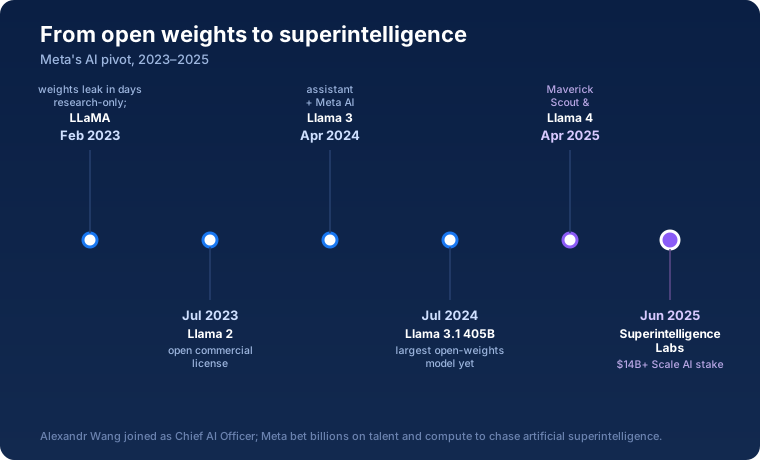
On February 24, 2023 — just months after ChatGPT had made large language models a household phenomenon — Meta AI announced LLaMA, a family of models built by its research lab under chief AI scientist Yann LeCun. The pitch was contrarian. While OpenAI and Google guarded their models behind APIs, Meta released LLaMA to researchers and published a paper claiming its 13-billion-parameter model beat OpenAI's 175-billion-parameter GPT-3 on most benchmarks, and that its largest 65B version was competitive with heavyweights like Google's PaLM and DeepMind's Chinchilla. Smaller, smarter, and — crucially — open.
Then the plan escaped Meta's hands. On March 3, 2023, barely a week after launch, the model's weights were uploaded as a torrent and the magnet link spread through 4chan and AI forums. Meta fired off DMCA takedown notices, but the genie was out. What could have been a corporate embarrassment turned into an accidental strategy: a global community of developers began fine-tuning and running LLaMA on consumer hardware. Commentators compared the moment to the release of Stable Diffusion — the point where a powerful technology stopped belonging to a handful of labs.
Meta leaned in. In July 2023 it released Llama 2 with an actual open commercial license and, for the first time, instruction-tuned chat versions alongside the raw foundation models. The logic was pure Zuckerberg: if the industry standardized on Meta's free models the way it had standardized on Meta's open-source PyTorch framework (released by the lab back in 2017), then no rival could charge a toll on the technology Meta depended on. Openness wasn't charity. It was leverage.
Scaling the open bet
The releases came faster and bigger. April 2024 brought Llama 3, and with it Meta AI — a consumer assistant woven directly into Facebook, Instagram, and WhatsApp, putting a chatbot in front of billions of existing users without asking them to download anything new. That July, Llama 3.1 arrived with a 405-billion-parameter version, at the time the largest openly available model on earth, a direct shot at the closed frontier labs.
By April 2025, Meta shipped Llama 4 as two models, Scout and Maverick, under a source-available community license. The strategy had clearly worked at one level: Llama had become the default open foundation for startups, researchers, and enterprises worldwide, downloaded hundreds of millions of times. But at another level, cracks were showing. Reporting suggested Zuckerberg was privately unhappy with Llama 4's reception, and the frontier — the very best models — still belonged to OpenAI, Google, and Anthropic. Being everyone's free foundation was not the same as being the best.
The reinvention: chasing superintelligence
So Meta did what Meta does when it feels behind: it spent enormous amounts of money, fast. In June 2025 the company founded Meta Superintelligence Labs, an explicit bet not on better chatbots but on artificial superintelligence itself. The centerpiece was a deal to pour more than $14 billion into a 49% non-voting stake in Scale AI, the data-labeling and benchmarking company — and to install its 28-year-old founder Alexandr Wang as Meta's Chief AI Officer. Former GitHub CEO Nat Friedman came aboard to lead product, and Meta reportedly chased acquisitions of Safe Superintelligence, Thinking Machines Lab, and Perplexity, all unsuccessfully, while dangling nine-figure packages to poach top researchers.
It was a stunning pivot for a company built on social software. The lab that began in 2013 as Facebook AI Research, that had quietly given the world PyTorch and the Llama family, was being reorganized around a single audacious goal — and the new regime was not sentimental about the old one. The transition was turbulent: a larger model, codenamed Behemoth, was under development amid Zuckerberg's frustration; the labs would later see layoffs; and in November 2025 Yann LeCun, the intellectual architect of Meta's open-research culture, departed to start his own venture.
That is where the arc of this series lands. Facebook began in a Harvard dorm room in 2004 as a way to rank classmates' faces. Two decades later, Meta was spending tens of billions chasing machine minds smarter than any human. The through-line is the same restless instinct that has driven the company from the start: move fast, absorb what threatens you, and never let a platform shift happen without trying to own it — whether that platform is the social graph, the smartphone feed, the metaverse, or intelligence itself.
The Rise of Facebook is, in the end, the story of a company that refused to stay one thing. Whether the superintelligence gambit becomes its greatest triumph or its most expensive detour is a chapter still being written — but if the last twenty years are any guide, Meta will not sit out the fight.
That closes our 20-part journey through the rise of Facebook — from a dorm-room website to a company betting its future on superintelligence. Thank you for reading along.
Comments
Post a Comment