In the summer of 2004, Mark Zuckerberg told his parents he was going to California for a couple of months. TheFacebook was exploding across campuses, and he wanted to work on it somewhere warm before returning to Harvard in the fall. He rented a sublet in Palo Alto with Dustin Moskovitz and a few others, set up laptops on folding tables, and got to work.
He never went back to Harvard. That "summer trip" was the moment TheFacebook stopped being a college project and started becoming a company — and the person who pushed it hardest in that direction had already talked his way into the house.
Enter Sean Parker
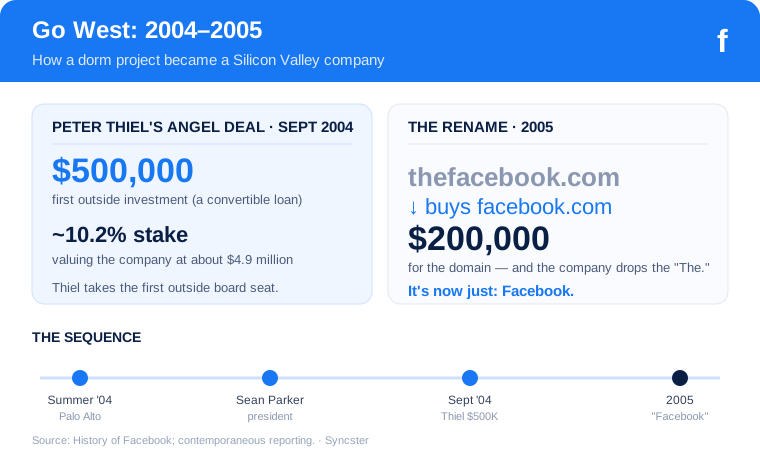
Sean Parker was 24 and already a Silicon Valley legend of the cautionary kind. He'd co-founded Napster, the file-sharing service that terrified the music industry, and later Plaxo, and had been forced out of both. But he understood social products and startup mechanics better than almost anyone Zuckerberg had met. Parker had spotted TheFacebook early, connected with Zuckerberg, and — in a bit of startup serendipity — ended up crossing paths with the Palo Alto crew and moving in. He became the company's first president.
Parker's real contribution wasn't a feature; it was structure. He'd been burned twice by losing control of his own companies, and he was determined that Zuckerberg wouldn't repeat his mistakes. He helped properly incorporate the business, brought in lawyers, and set up a share structure designed to keep voting control firmly in Zuckerberg's hands even as outside money came in. That obsession with founder control would define Facebook for the next two decades — it's why, twenty years and several scandals later, Zuckerberg still can't be voted out.
The $500,000 that started it all
A company needs money, and in September 2004 it got its first real check. Through Parker's network, Zuckerberg was introduced to Peter Thiel — the co-founder of PayPal, now an investor. Thiel liked what he saw: a product that had already conquered the hardest, most desirable market in the country (elite college students) without spending a dollar on marketing.
Thiel put in $500,000 as an angel investment, structured as a loan that would convert to equity. It bought him roughly 10.2% of the company and valued the whole thing at about $4.9 million. He also took the first outside seat on the board. It was the first outside investment in Facebook's history — and one of the greatest angel investments ever made, eventually worth over a billion dollars when he sold most of his stake years later.
Just as important as the cash was the signal. Thiel's money turned a viral campus toy into a venture-backed Silicon Valley startup, with a board, a cap table, and expectations.
Dropping the "The"
There was still the awkward matter of the name. "TheFacebook" was clunky, and the clean domain — facebook.com — belonged to someone else. In 2005, the company bought it for $200,000. With the new domain came a new, sleeker identity: they dropped the definite article, and "TheFacebook" simply became Facebook. It's a small change that tells you everything about the ambition forming inside that Palo Alto house — this was no longer the facebook for one campus. It was going to be Facebook, full stop.
The Parker era wouldn't last. His run as president would end in 2005 under a cloud, and his day-to-day influence faded — but the company he helped shape kept his fingerprints: the founder-control structure, the venture money, the swagger. In barely a year, five undergraduates and one exiled wunderkind had turned a directory into a business that serious investors were now betting on.
The next challenge wouldn't come from a rival or a regulator. It would come from Facebook's own users — and a single feature that nearly caused a revolt.
Next time — Part 4: in 2006 Facebook launches the News Feed, and hundreds of thousands of users revolt against the very feature that would make it unstoppable.
Comments
Post a Comment