By the summer of 2006, Facebook was a two-year-old company run out of Palo Alto by a 22-year-old who had dropped out of Harvard. It had spread to colleges and, that fall, was about to open its doors to anyone with an email address. It was growing fast, losing money, and — on paper — worth nothing until someone was willing to pay for it. That summer, someone was. Yahoo, then one of the giants of the web, offered to buy the whole thing for $1 billion.
For most founders, that is not a decision. That is a lottery ticket that has already been scratched. Mark Zuckerberg's personal stake would have been worth somewhere around $250 million — generational, walk-away money for a kid who was barely old enough to rent a car. And yet the single most important moment in Facebook's history, as one of its earliest backers would later put it, was the eight hours the company spent deciding not to take it.
The ten-minute meeting that lasted eight hours
Peter Thiel, the PayPal co-founder who had written Facebook's first outside check, sat on a three-person board alongside Zuckerberg and Accel Partners' Jim Breyer. They gathered on a Monday morning to decide whether to sell. Zuckerberg opened the meeting as if the answer were obvious. As Thiel later recounted it: "Mark sort of started the board meeting and said, 'You know this is just a pro forma thing. We're just going to talk about this for 10 minutes because we have to have a quick board meeting to turn it down. I'm not taking it.'"
The two investors pushed back. You're 22, they reasoned. You'll walk away with $250 million. Think about everything you could do with that. Zuckerberg's answer has since become part of Silicon Valley folklore: "I don't actually know what I would do with the money. I would probably just start another social networking company. But I already have one, so why would I sell it?"
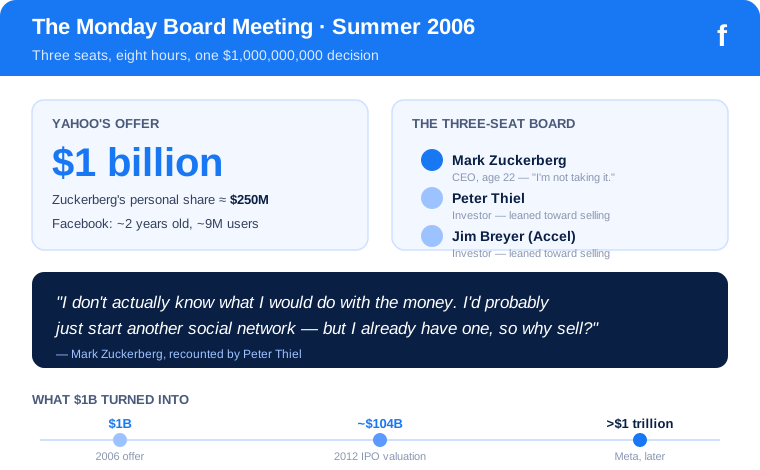
The "ten-minute" meeting stretched to roughly eight. Both Thiel and Breyer initially leaned toward taking the money — a billion dollars for a company still figuring out how to turn a profit was a serious, defensible offer. But by the end of the day the board sided with its founder. Facebook would not be sold.
Why the numbers made it easier to say no
Conviction was the headline, but timing helped. In the weeks around the offer, Yahoo's own stock stumbled after a disappointing earnings warning, and — as chronicled in David Kirkpatrick's The Facebook Effect — the effective price the deal implied slipped well below the original billion-dollar figure. A softening offer from a company that suddenly looked shaky made it far easier for a nervous board to hold the line. What might have been an agonizing choice at a firm, rising $1 billion became a much simpler "no" against a wobbling one.
There was also what was happening inside Facebook itself. That same September, the company launched the News Feed and opened registration to the general public. The backlash to the News Feed was ferocious — but the engagement numbers underneath it were extraordinary. People weren't just joining; they were living on the site. To Zuckerberg, that was the whole argument. Why cash out of something that was, by every internal metric, only just getting started?
The bet that defined the company
Thiel later framed the refusal as a kind of law of technology: "Any super successful, super big tech company is one where you've been offered multiple times… people have offered to buy it, and you chose never to sell it." Saying no to Yahoo wasn't recklessness dressed up as vision. It was a founder who genuinely believed the thing he was building was worth more than any check being waved at it — and who had the ownership and the nerve to act on that belief.
The scoreboard eventually settled the argument. The company Yahoo valued at $1 billion in 2006 went public in 2012 at a valuation north of $100 billion, and the business that became Meta would later be worth well over a trillion. The $250 million Zuckerberg turned down became, on paper, tens of billions. It remains one of the most consequential "no"s in business history — the moment a 22-year-old bet his entire fortune that he was right and the market was wrong.
Next: the platform opens up — apps, explosive virality, and a privacy experiment called Beacon that blew up in Facebook's face.
Comments
Post a Comment