By 2007, Facebook had won its war of features and turned down a billion dollars. It had tens of millions of users and a News Feed that kept them glued to the site. But Zuckerberg wanted something bigger than a website — he wanted a platform, the thing other people build on top of. In 2007 he got his wish twice over: once triumphantly, and once catastrophically.
The door swings open
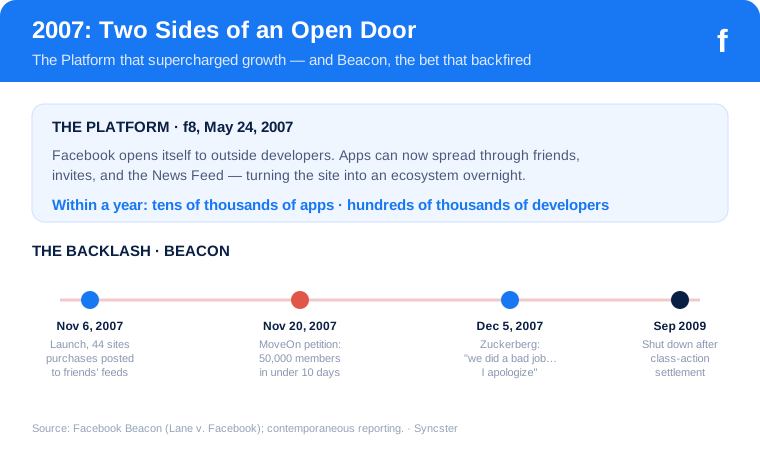
On May 24, 2007, at its first f8 developer conference, Facebook launched the Facebook Platform. The idea was radical for its time: let outside developers build applications that ran inside Facebook, using its data and, crucially, its social graph. A quiz, a game, a music-sharing app — anyone could make one, and any user could add it.
What made the Platform explosive wasn't the apps themselves; it was virality. An app could spread by riding the very channels that made Facebook addictive: friend invitations, notifications, and posts in the News Feed. Install a movie-trivia app and your friends saw it, tried it, and spread it to theirs. Apps like iLike and Causes rocketed from zero to millions of users in weeks — growth curves no standalone website could dream of. Within a year, the Platform hosted tens of thousands of applications built by hundreds of thousands of developers. Facebook had turned itself from a destination into an economy. (It also, less gloriously, unleashed a plague of app-invite spam — but that was a problem of abundance.)
This was the blueprint Zuckerberg would follow forever: own the graph, then let everyone else build on it. It's the same instinct that later made mobile, and then AI, existential priorities. But 2007 also taught him — the hard way — exactly where the line was.
Beacon: the bet that backfired
Facebook needed to make money, and Zuckerberg had a theory that would define the next fifteen years: the most powerful advertising isn't an ad at all — it's your friends' behavior. On November 6, 2007, Facebook launched Beacon, a system that partnered with 44 external websites — Fandango, Overstock, Blockbuster and others. When you bought a movie ticket or a product on a partner site, Beacon reported it back to Facebook and broadcast it into your friends' News Feeds: "Alex bought this on Overstock."
The problem was consent — there wasn't any. Purchases showed up in feeds by default, and reporting happened even when users weren't logged in and hadn't agreed. The now-legendary horror story: a man's secret purchase of a diamond ring was announced to his wife by Facebook, spoiling the surprise. People were furious, and rightly so.
50,000 signatures in ten days
The backlash was immediate and organized. On November 20, 2007, the civic group MoveOn.org launched a petition demanding Facebook stop publishing off-site activity without explicit permission. It drew 50,000 members in under ten days. Worse, a security researcher soon demonstrated that Beacon was still collecting data even from users who had opted out and logged off — directly contradicting Facebook's public assurances.
Faced with the first real revolt of the paying era, Zuckerberg did something he'd get better at over the years: he apologized. On December 5, 2007, he posted, “We simply did a bad job with this release, and I apologize for it.” Facebook made Beacon opt-in, then gave users a way to turn it off entirely. It wasn't enough. A class-action suit, Lane v. Facebook, followed, and Beacon was quietly shut down in September 2009. Years later, Zuckerberg would flatly call it a “mistake.”
But the underlying conviction never died. Beacon failed because it took people's data without asking — not because Zuckerberg was wrong that social behavior was advertising gold. That idea would come back, done far more carefully and far more profitably, the moment the right executive walked through the door. She was about to.
Next time — Part 7: in 2008, Sheryl Sandberg leaves Google for Facebook and builds the advertising machine that finally makes it profitable.
Comments
Post a Comment