By the end of 2007, Facebook had a problem most companies would kill for: fifty-odd million users, explosive growth, a platform teeming with apps — and almost no idea how to turn any of it into a durable business. Mark Zuckerberg was 23, brilliant at building product, and openly uninterested in the grubby mechanics of selling ads. What the company lacked wasn't ambition. It was an adult in the room who understood how to make money at scale. That person walked in at a Christmas party.
The hire that changed everything
Sheryl Sandberg was not an obvious fit for a hoodie-and-flip-flops startup. Born in Washington, D.C. in 1969, she'd earned both her undergraduate degree and her MBA at Harvard, served as chief of staff to Treasury Secretary Lawrence Summers during the Clinton administration, and then spent nearly seven years at Google as vice president of global online sales and operations. At Google she had done exactly the thing Facebook desperately needed: she'd helped turn a beloved product with no revenue model into an advertising juggernaut, scaling the sales and operations engine behind AdWords and AdSense.
Zuckerberg met her at a holiday party in December 2007, and the two began a series of long conversations — over dinners, at his apartment, walking around — about what Facebook could become. He didn't post a job listing; he essentially recruited her one dinner at a time. In March 2008, Sandberg joined as chief operating officer. She was 38. Zuckerberg would keep building the product and setting the vision; she would build the business, the org, and eventually become the company's public face in Washington and on Wall Street. She also became the first woman elected to Facebook's board of directors.
Deciding what Facebook would sell
The most important thing Sandberg did in her first months wasn't a deal or a hire — it was a decision. Facebook had dabbled in banner ads and had launched, and then walked back, the privacy-shredding Beacon program in 2007. There was no consensus on how the company should make money. Sandberg reportedly ran a series of evening meetings with the leadership team to answer one question: what is our business?
The answer they converged on was advertising — but a specific, defensible kind of advertising. Facebook wouldn't try to out-Google Google on search intent. Instead it would sell something no one else had: the ability to reach people based on who they actually were. Age, location, relationship status, employer, interests, the pages they liked, the things their friends did. Where Google captured demand — you type "running shoes," it shows you shoe ads — Facebook could create demand, putting a brand in front of exactly the audience most likely to care, before they'd even gone looking.
That distinction became the foundation of a machine that would, within a few years, print money.
Building the money machine
Sandberg's genius was operational. She brought the Google playbook and adapted it: a professional sales organization, self-serve tools that let any small business buy an ad with a credit card, measurement systems so advertisers could see what they were getting, and a relentless focus on filling the enormous, growing inventory of ad space that all those users' feeds represented. She hired seasoned executives, imposed structure on a chaotic startup, and translated Zuckerberg's product decisions into revenue.
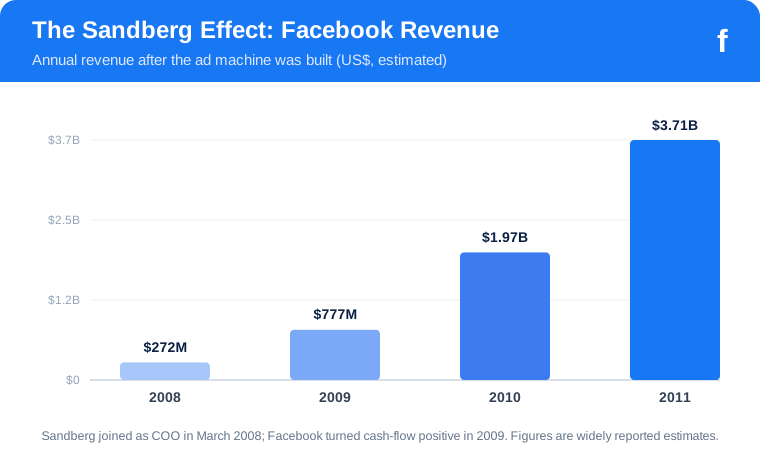
The numbers tell the story. When Sandberg arrived, Facebook was burning cash and, by most accounts, generated on the order of a few hundred million dollars in 2008. Under her, the company turned cash-flow positive in 2009 — a milestone Zuckerberg had once treated as almost beside the point. Revenue then compounded ferociously: roughly $777 million in 2009, close to $2 billion in 2010, and about $3.7 billion in 2011. By the time Facebook filed to go public in 2012, the advertising business Sandberg had built was the entire financial argument for the company's valuation.
The partnership at the top became one of the most studied in modern business: the young founder with total control of product and vision, paired with the older, politically fluent operator who handled everything else. It let Zuckerberg stay Zuckerberg — a builder who never had to pretend to love spreadsheets — while the company grew into a global corporation. Sandberg would go on to write Lean In in 2013 and become a cultural figure in her own right, but her most consequential work was this: she gave Facebook a way to pay for its ambitions.
The engine was now running. But before the world would see Facebook as a business, it would see it as a story — a dramatized, Oscar-nominated story that fixed a particular myth of the founding in the public imagination. Next time: the lawsuits, the movie, and The Social Network.
Comments
Post a Comment