By 2008, Facebook had a hit product, a booming ad business, and a brand-new chief operating officer. What it did not have was a clean origin story. The question that had trailed Mark Zuckerberg since his Harvard dorm room — whose idea was this, really? — was about to be answered twice: once by a courtroom, and once, far more memorably, by Hollywood.
Two lawsuits, one question
The first challenge came from three fellow Harvard students. In December 2002, Cameron Winklevoss, his twin brother Tyler, and their friend Divya Narendra had begun sketching a campus social network they called HarvardConnection (later ConnectU). In November 2003 they recruited a sophomore programmer to help finish it: Mark Zuckerberg. Weeks later he stopped returning their messages — and in February 2004 launched TheFacebook instead. The Winklevosses claimed he had stolen their idea and stalled them on purpose.
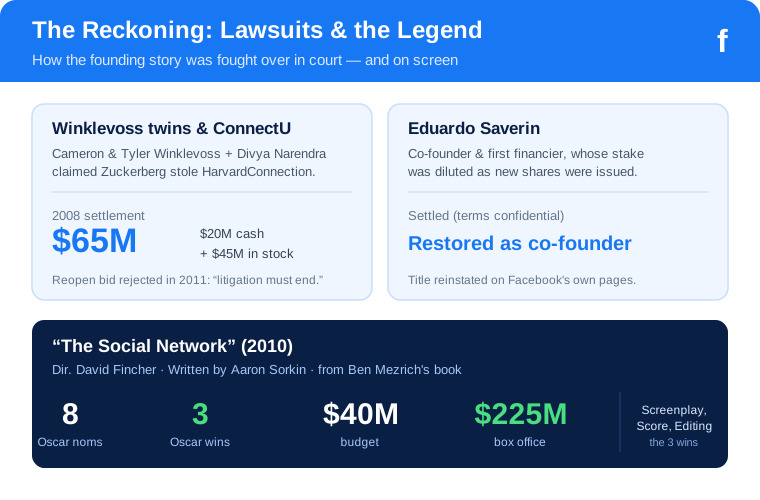
Years of litigation followed. In 2008, the two sides settled. Facebook agreed to pay roughly $65 million — about $20 million in cash and the rest, some $45 million, in Facebook stock. It was a fortune, but the Winklevosses came to regret the shape of the deal. They argued the shares had been valued too high, effectively shrinking what they received, and tried to reopen the case. In 2011 a federal appeals court shut the door. “At some point,” wrote Judge Alex Kozinski, “litigation must come to an end. That point has now been reached.” Ironically, the stock they resented would later balloon in value, quietly making the settlement one of the better paydays of the whole saga.
The second challenge came from closer in. Eduardo Saverin was Zuckerberg’s original business partner and the friend who put up the first real money to keep the site running. But as Facebook restructured and took on investment, new shares were issued and Saverin’s ownership was diluted from a meaningful slice to a sliver. He sued. The terms of their settlement stayed confidential, but the visible result was telling: Saverin was formally restored to the story as a co-founder, his title reinstated on Facebook’s own pages.
The movie that rewrote the myth
If the lawsuits settled the legal questions, they did nothing to settle the public one. That job fell, improbably, to a feature film. In 2009 writer Ben Mezrich published The Accidental Billionaires, a dramatized account built partly on Saverin’s cooperation. Screenwriter Aaron Sorkin turned it into a script, and director David Fincher turned the script into The Social Network, released in October 2010.
It was not the movie anyone expected a website to inspire. Jesse Eisenberg played Zuckerberg as a brilliant, wounded striver; Andrew Garfield played Saverin as the loyal friend cut out of the deal; Justin Timberlake played Napster co-founder Sean Parker as the charming devil on Zuckerberg’s shoulder; and Armie Hammer played both Winklevoss twins. Made for about $40 million, it earned some $225 million worldwide and swept awards season — eight Academy Award nominations, three wins (Adapted Screenplay, Original Score, and Film Editing), plus the Golden Globe for Best Drama.
Crucially, the film framed the birth of Facebook as a story of betrayal and social insecurity — a boy building a global network because he couldn’t get a girl or a spot in a Harvard final club. It was gripping. It was also, Zuckerberg insisted, wrong.
The myth versus the man
Zuckerberg’s public response was pointed but dry. The filmmakers, he noted, got the surface details right — even his actual wardrobe of T-shirts, hoodies, and sandals — while inventing the motive. “They just kind of made up a bunch of stuff that I found kind of hurtful,” he said, adding that the idea he built Facebook to impress people or join clubs missed the truth: he and his friends simply liked building things. The most revealing line came later, and he made it flattering by accident — the movie, he said, got the clothes and the code right and the reason completely backwards.
Whatever its accuracy, the film did something no press release could: it fixed a version of Facebook’s founding in the public imagination. A generation now “knows” the story through Sorkin’s dialogue, not the court filings. And there was a strange business upside. Just as the movie painted Zuckerberg as ruthless, it also cemented him as a defining figure of his era — a 26-year-old whose company was interesting enough to dramatize. Myths, it turns out, are their own form of marketing.
The lawsuits closed the books on who could claim a piece of Facebook. The movie decided how the world would remember it. Neither slowed the company down for a moment — because while the courts and cameras looked backward, Facebook was busy racing toward a number no social network had ever reached.
Next in the series: “Move Fast and Break Things” — the growth machine that pushed Facebook past half a billion users.
Comments
Post a Comment