By 2002, the music business was in open panic. Napster had shown a whole generation that any song ever recorded could be had for free, in seconds, from a dorm-room PC. CD sales were sliding. Lawsuits were flying. The industry's answer to digital music was a mess of half-built stores with clumsy rules, thin catalogs, and monthly subscriptions that left you with nothing if you stopped paying. Nobody had cracked the one thing that mattered: making it easier to buy a song than to steal one.
Apple had a peculiar vantage point on all this. The iPod had arrived in 2001 and was selling well, but it was a beautiful vessel with no legal river to fill it. You could rip your own CDs — and plenty of people filled their iPods with downloads of murkier origin. Steve Jobs saw both the hole in the market and the leverage it gave him. If he could get the music, the iPod became unstoppable. And he had something the labels were desperate for: a way to sell singles again.
The deal that saved the labels
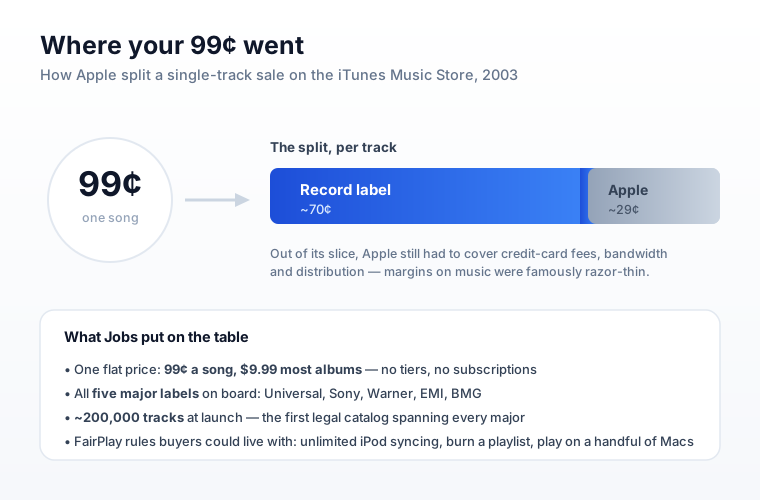
The hard part was never the software. It was convincing five terrified, litigious record companies to hand their crown jewels to a computer company with barely 3% of the PC market. Jobs spent much of 2002 in meetings with Universal, Sony Music, Warner, EMI, and BMG, personally charming executives who had every reason to say no. His pitch was almost suspiciously simple: one flat price, 99 cents a song, $9.99 for most albums. No tiers. No subscriptions. You buy it, you own it.
Crucially, Jobs argued that piracy wasn't a technology problem to be locked down — it was a convenience problem. People pirated because the legal options were worse. Make buying frictionless and fair, he said, and a huge number of people would simply pay. He also made the labels an offer they could stomach precisely because Apple was small: the store launched Mac-only, reaching a sliver of computer users. If it flopped, the damage would be contained. That modest footprint was the Trojan horse that got the doors open.
The economics were deliberately generous to the labels and brutal to Apple. Of every 99 cents, the record company took the lion's share; Apple kept a thin slice that had to cover credit-card fees, bandwidth, and running the whole operation.
Jobs didn't much care about making money on the songs. The margin lived in the iPod. The store existed to sell the hardware — and to make the iPod the most desirable thing you could own. It was one of his favorite tricks: give away the thing competitors obsess over, and win on the thing they ignore.
99 cents, 200,000 songs, one week
On April 28, 2003, Jobs unveiled the iTunes Music Store with a catalog of around 200,000 tracks — the first legal store to span every major label at once. The experience was the pitch made real. You browsed inside iTunes, clicked Buy Song, typed nothing more than a password, and the track dropped straight onto your Mac and iPod seconds later. No shopping cart, no shrink wrap, no waiting.
The copy-protection layer, called FairPlay, was the quiet diplomatic achievement. The labels demanded locks; Jobs insisted the locks be invisible enough that honest buyers wouldn't feel punished. So a purchased song would sync to unlimited iPods, play on a handful of your own computers, and burn to CD as part of a playlist. It was restrictive enough to sign the contracts and loose enough that ordinary people barely noticed.
The verdict came fast. In its first week, the store sold over a million songs — from a catalog available only to Mac owners, a group that made up a small fraction of all computer users. The message was unmistakable: given a store that respected them, people were happy to pay for music they could have taken for free.
Breaking out of the walled garden
The million-songs-a-week pace was the proof Jobs needed to make his next move: iTunes for Windows, which shipped in October 2003. Jobs reportedly called it the best Windows app ever written — a backhanded way of saying Apple was finally letting the other 97% of the world buy songs and, not coincidentally, buy iPods. Sales didn't just grow; they detonated. Within a few years the iTunes Store had become the largest music retailer in the United States, then the world, racking up billions of downloads one 99-cent click at a time.
The ripple effects reshaped the entire industry. The album — the unit the business had been built on for decades — was quietly unbundled back into singles. Pricing power shifted from label boardrooms toward a single flat number set in Cupertino. And a company known for computers had just become the gatekeeper of how the world bought music. The labels had been saved, but on Apple's terms, and they would spend years uneasy about the deal they'd signed.
Most importantly for Apple, the formula was now proven: great hardware, married to a frictionless store, selling things people had assumed could never be sold online. Jobs had just run the dress rehearsal for something far bigger — a device that would fold the iPod, the phone, and the whole store into a single slab of glass.
Next in the series: 2007 — the keynote that reinvented the phone, and bet the entire company on it.
Comments
Post a Comment