By the middle of the 1990s, the company that had taught the world what a personal computer could feel like was running out of road. The Macintosh still had its believers — designers, publishers, teachers, a devoted core who would sooner switch careers than switch platforms. But belief doesn't pay payroll. Windows 95 had arrived with a Start button and a billion-dollar marketing campaign, the clone makers were eating Apple's own lunch, and inside Cupertino the executive suite had become a revolving door. The business press settled on a single adjective and used it so often it practically fused to the company's name: beleaguered Apple.
This is the chapter where the story almost ends.
The diesel runs out of fuel
When John Sculley was pushed out in October 1993, the board handed the wheel to Michael Spindler, a German operations man nicknamed “The Diesel” for his grinding work ethic. Spindler was a strategist, not a showman — after becoming CEO he didn't make a public appearance for four months. “I never was an operations guy,” he later admitted. “That's not my strength at all.”
He inherited real assets: the PowerPC chip, built with IBM and Motorola, was genuinely fast. But he also inherited two tar pits. The Newton handheld had shipped before it was ready and become a punchline. And Copland — the ambitious next-generation Mac operating system meant to leapfrog Windows — kept slipping, its ship date receding like a mirage. Spindler cut hard: layoffs, frozen salaries, killed projects. When that wasn't enough, he went looking for a buyer. During his tenure Apple quietly opened merger talks with IBM, with Sun Microsystems, and with Philips. Every one of them went nowhere. On February 2, 1996, the board replaced him.
A ship with a hole in the bottom
His successor was Gil Amelio, a physicist who had helped demonstrate the first working charge-coupled device at Bell Labs and then turned around National Semiconductor. He walked into Apple and found, by his own accounting, a company with a cash shortage, uneven product quality, no viable operating-system strategy, and a culture pulling in too many directions at once. His metaphor became famous: “Apple is like a ship with a hole in the bottom, leaking water, and my job is to get the ship pointed in the right direction.” The obvious rejoinder — that a leaking ship needs the hole fixed, not a new heading — wrote itself.
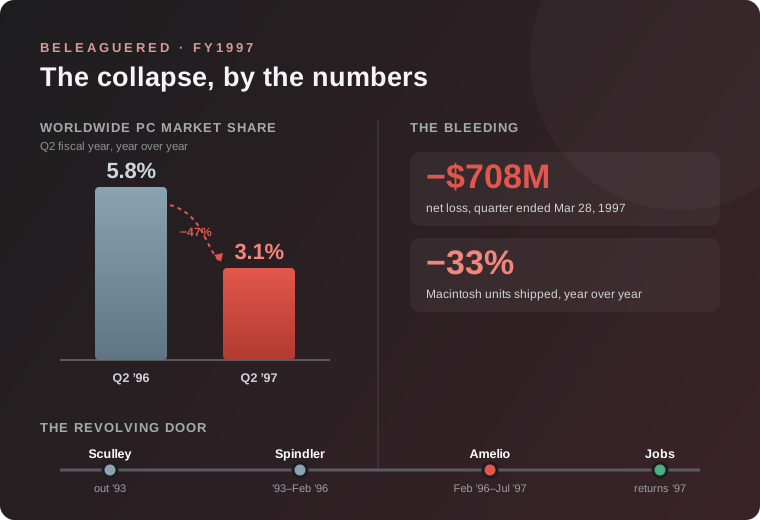
The numbers were brutal, and they were not spin. In the quarter ending March 28, 1997, Apple lost $708 million — among the largest losses in Silicon Valley history to that point. Macintosh unit shipments fell 33% year over year. And the market share that had once defined Apple as the alternative to the beige PC collapsed: worldwide, Apple's slice of the PC market dropped to 3.1% from 5.8% a year earlier. The clone-licensing experiment, meant to expand the Mac's reach, had instead let companies like Power Computing undercut Apple on its own hardware.
Amelio did the responsible, unglamorous things. He cut roughly a third of the workforce. He finally killed Copland, which was never going to ship. And he went shopping for an operating system to replace it, because Apple could no longer afford to build one from scratch. The first stop was Be Inc., the startup founded by former Apple executive Jean-Louis Gassée, whose sleek BeOS looked like exactly what the Mac needed. But Gassée, sensing Apple's desperation, held out for $275 million. Apple wouldn't go past $200 million. The talks stalled — which turned out to be the luckiest failure in the company's history.
The quote that aged like milk
Because the other option on the table was a company called NeXT, run by a man Apple had exiled eleven years earlier. In November 1996, Amelio opened discussions with Steve Jobs. On December 20, Apple announced it would buy NeXT for roughly $400 million — acquiring not just an elegant, Unix-based operating system that could finally anchor the Mac's future, but Jobs himself, who returned to the company he co-founded as an adviser to the CEO.
Almost nobody read it as a turning point at the time. The mood was funeral. Apple's stock slid to a twelve-year low in the spring of 1997. That summer, asked at a Gartner conference what he would do if he were running the dying company, Dell Computer's Michael Dell delivered the sentence that would follow him for the rest of his career: “I'd shut it down and give the money back to the shareholders.” Apple shares were trading around $17. The verdict from the industry was effectively unanimous — the beleaguered company was a dead firm walking.
What almost no one outside a few boardrooms could see was that the adviser Amelio had just brought back had other plans. Within months Jobs would maneuver Amelio out, take the interim wheel himself, and start fixing the hole in the bottom of the ship. The company that everyone had written off was about to become the greatest comeback story in the history of business — but first it needed to survive the summer, and it needed cash from a very unlikely place.
Next time — Part 9: The Return. Jobs retakes the company, slashes the product line to four boxes, and walks onstage to announce a $150 million lifeline from the one rival everyone least expected: Microsoft.
Comments
Post a Comment